Voltage follower (buffer)
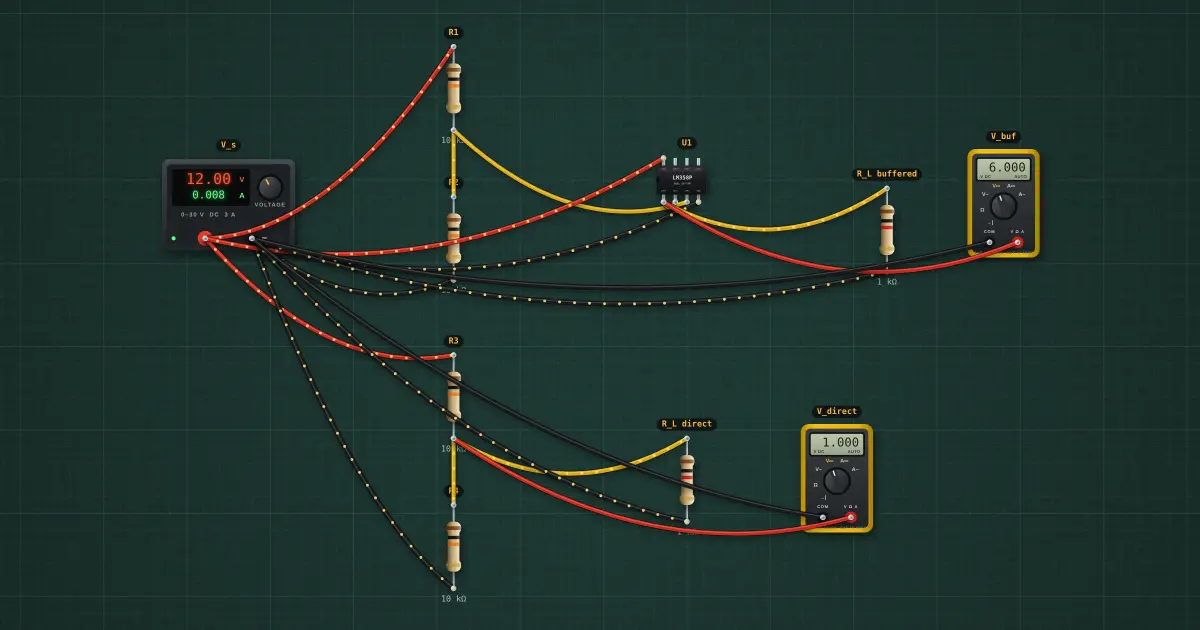
A divider makes a voltage, but loading it pulls that voltage down. An op-amp wired as a follower (OUT tied to IN−) copies the voltage while taking almost no current from the divider, then drives the load from its own supply.
Open this lesson in the labFree, in your browser, no account needed.
How it works
Unloaded divider: V = 12 × R2 / (R1 + R2) = 6 V
Loaded directly: R4 ∥ R_L = 909 Ω, so V = 12 × 909 Ω / (10 kΩ + 909 Ω) = 1 V
Buffered: the op-amp input draws nanoamps, so the divider stays at its unloaded voltage and the op-amp supplies the 6 mA the load needs.
Try it on the bench
- Change R_L buffered to 100 Ω: the LM358 hits its 30 mA current limit and the output sags.
- Raise V_s to 20 V: the follower tracks 10 V. The LM358 output only reaches about V+ − 1.5 V, so watch what happens above that.
Parts on the bench
In the course
Zen’s Electronics Design Mastery, module “Op-Amps & Analog ICs”.