Sallen–Key low-pass filter
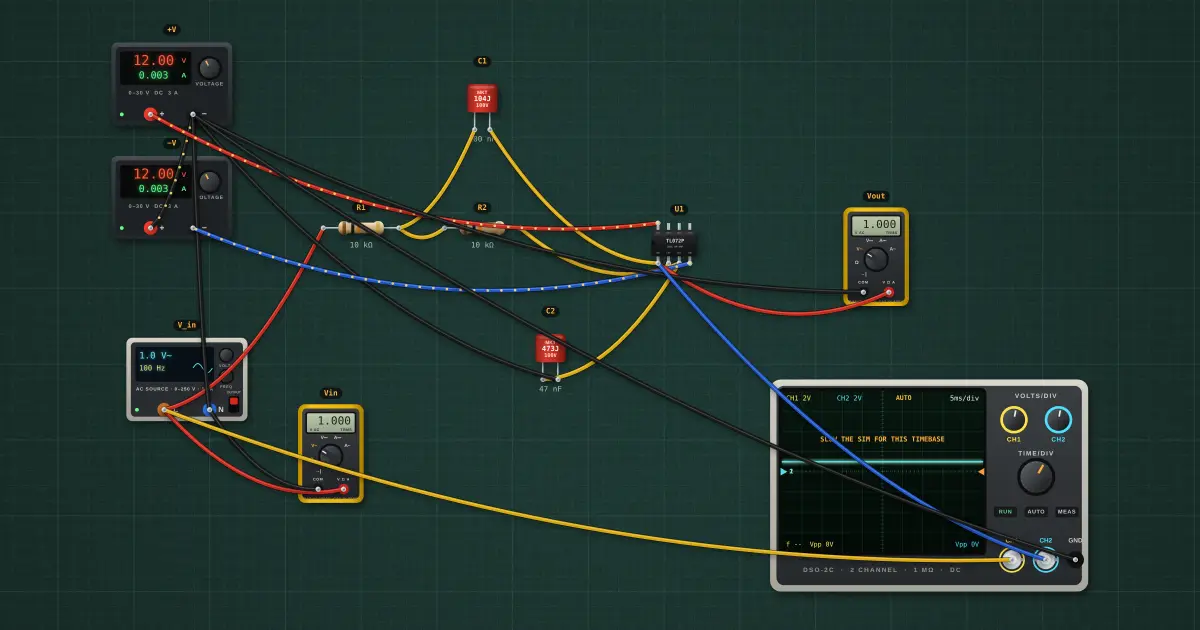
Two RC stages and an op-amp follower make a second-order filter: flat in the passband, then falling 40 dB per decade, twice as steep as a single RC. Capacitor C1 to the output sets how sharp the corner is (Q).
Open this lesson in the labFree, in your browser, no account needed.
How it works
f0 = 1 / (2π√(R1R2C1C2)) = 232.2 Hz, Q = √(R1R2C1C2) / (C2(R1+R2)) = 0.729
H = 1 / (1 − (f/f0)² + j(f/f0)/Q): at 100 Hz, |H| = 0.994 (-0.1 dB), φ = -35.9°
Try it on the bench
- Set the source to the corner frequency: the gain is about Q and the phase −90°.
- Try 2.3 kHz, a decade above the corner: the output falls to about 1 %, where a single RC would still pass 10 %.
- Open Tools… → Bode plotter and run a sweep: read the −3 dB corner off the curve and compare it with fc in the theory. Change a part and run again; the two curves overlay.
Parts on the bench
- 2 × Bench power supply
- AC source
- 2 × Resistor
- 2 × Film capacitor
- Op-amp
- 2 × Digital multimeter
- Oscilloscope
In the course
Zen’s Electronics Design Mastery, module “Op-Amps & Analog ICs”.