Integrator
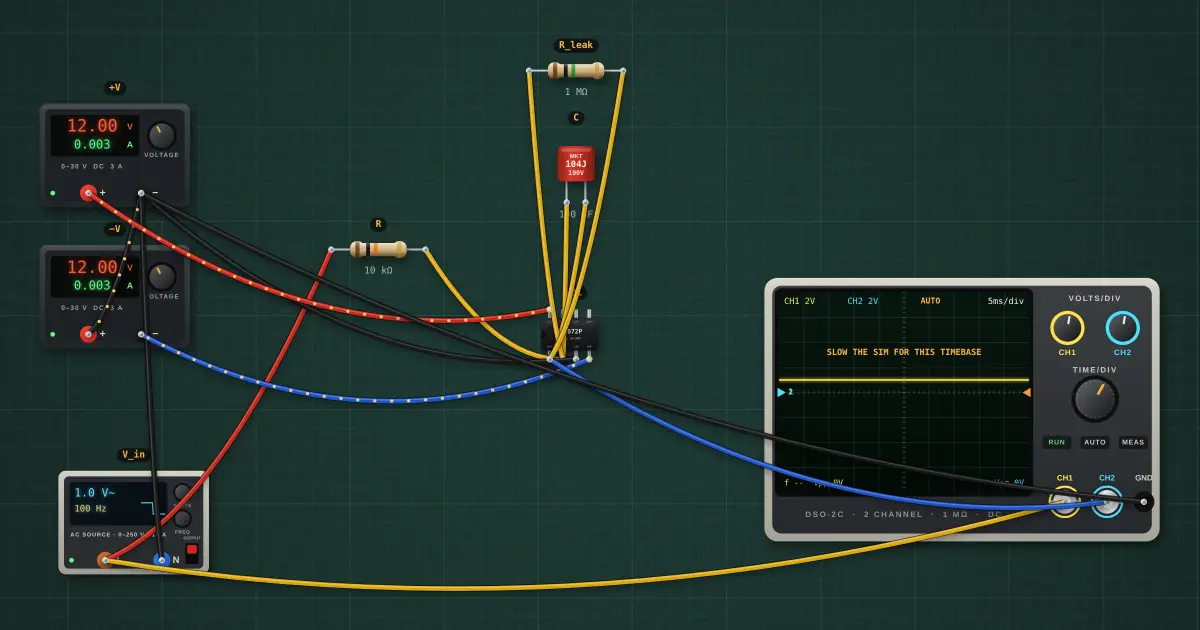
Put a capacitor in the feedback path. The input current V_in/R charges it at a steady rate, so the output ramps: V_out = −(1/RC)∫V_in dt. A square wave in gives a triangle out. The 1 MΩ across C stops slow drift.
Open this lesson in the labFree, in your browser, no account needed.
How it works
Slope while the input is +1 V: dV/dt = −V/(RC) = −1 kV/s
Each half-period lasts 5 ms, so the triangle spans V/(RC) × T/2 = 5 V peak to peak
It settles around 0 V with time constant R_leak·C = 100 ms.
Try it on the bench
- Halve the frequency to 50 Hz: the ramps run twice as long, so the triangle doubles.
- Switch the source to a sine: the integral of a sine is a cosine, shifted 90°.
Parts on the bench
- 2 × Bench power supply
- AC source
- 2 × Resistor
- Op-amp
- Film capacitor
- Oscilloscope
In the course
Zen’s Electronics Design Mastery, module “Op-Amps & Analog ICs”.