Non-inverting amplifier
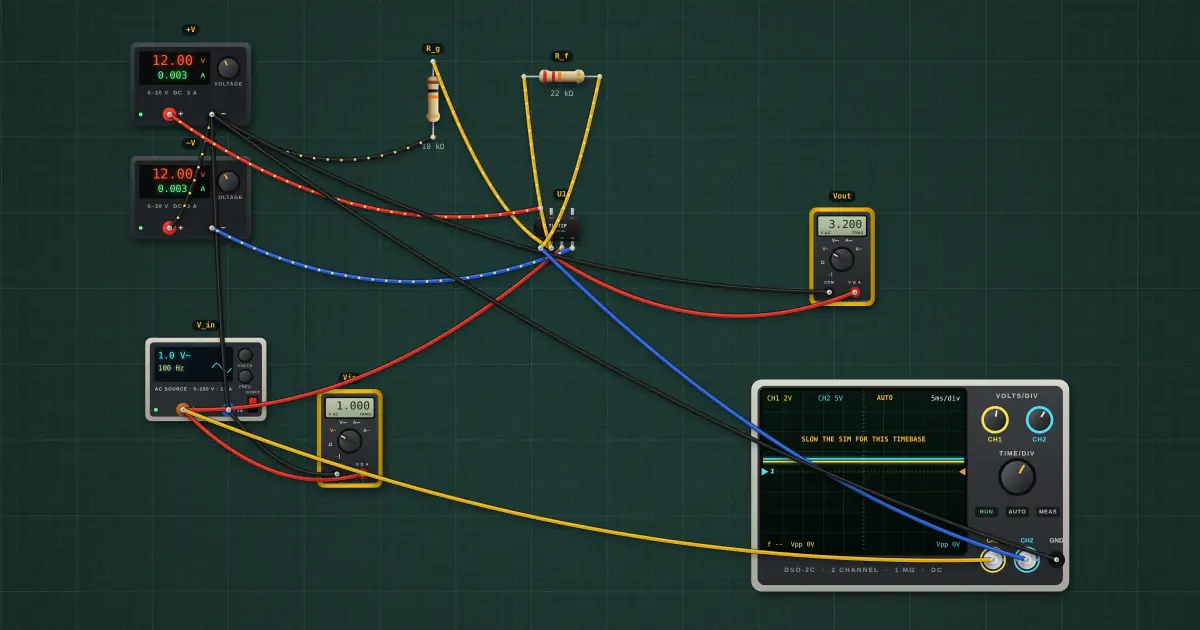
Feed the signal into IN+ and feed back a fraction of the output to IN−. The op-amp drives the output until that fraction equals V_in: V_out = (1 + R_f / R_g) · V_in, in phase, with a very high input impedance.
Open this lesson in the labFree, in your browser, no account needed.
How it works
Av = 1 + Rf / Rg = 1 + 22 kΩ / 10 kΩ = 3.20
Vout = 3.20 V RMS, in phase with the input. The source sees the op-amp’s input, which draws almost nothing.
Try it on the bench
- Raise R_f to 47 kΩ for a gain of 5.7.
- Remove R_g: the gain drops to 1, a voltage follower.
Parts on the bench
- 2 × Bench power supply
- AC source
- Op-amp
- 2 × Resistor
- 2 × Digital multimeter
- Oscilloscope
In the course
Zen’s Electronics Design Mastery, module “Op-Amps & Analog ICs”.