Schmitt trigger
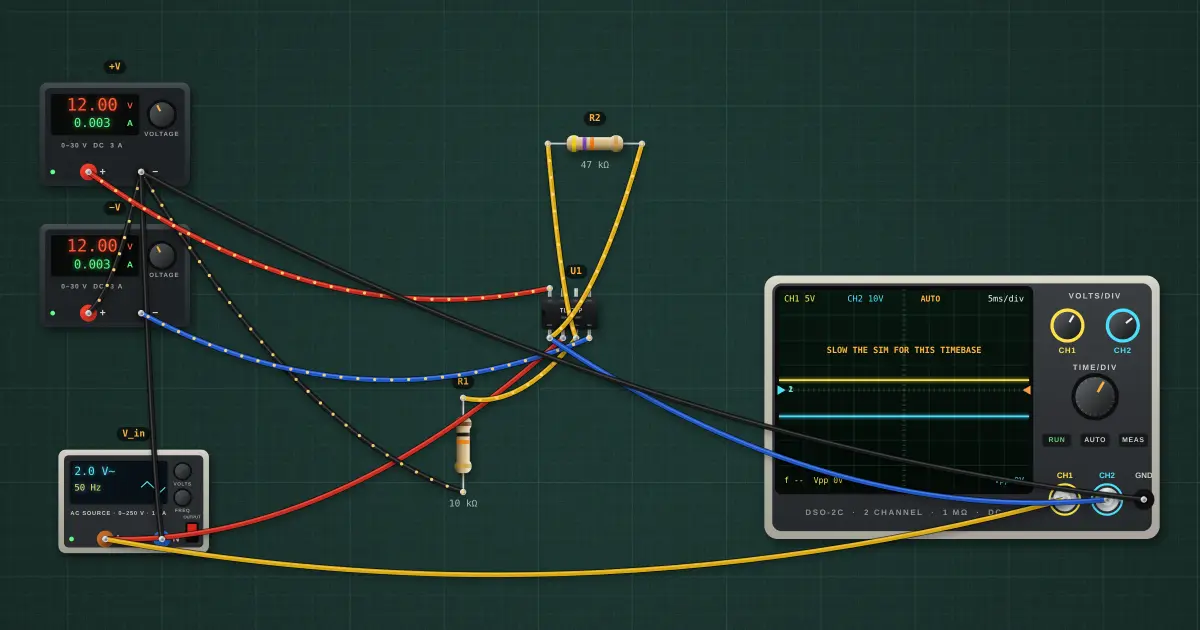
Positive feedback from the output to IN+ makes two thresholds: the output flips low when the input rises past the upper one and only flips back when it falls below the lower one. That hysteresis ignores noise on a slow signal.
Open this lesson in the labFree, in your browser, no account needed.
How it works
Feedback fraction β = R1/(R1+R2) = 0.175
Output swings to about ±10.5 V, so the thresholds are ±β·Vsat = ±1.842 V, a hysteresis band of 3.684 V.
Try it on the bench
- Lower R2 to 22 kΩ: the band widens. If it grows past the input peaks the output stops switching.
- Remove R2: with no feedback it becomes a plain comparator, flipping at 0 V.
Parts on the bench
- 2 × Bench power supply
- AC source
- Op-amp
- 2 × Resistor
- Oscilloscope
In the course
Zen’s Electronics Design Mastery, module “Op-Amps & Analog ICs”.