Diode forward and reverse bias
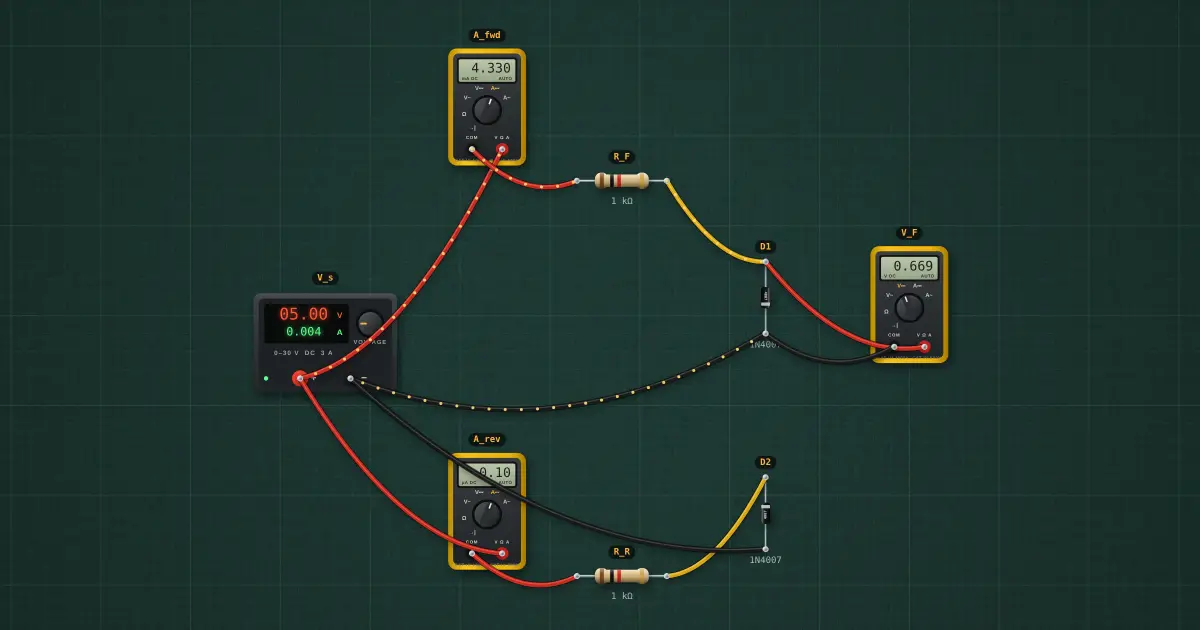
A diode is a one-way valve. Forward biased (anode positive) it conducts once about 0.6–0.7 V is across it, and that voltage barely rises however much current flows. Reverse biased it blocks almost completely.
Open this lesson in the labFree, in your browser, no account needed.
How it works
Shockley: I = Is(eV/nVT − 1), with Is = 7.20e-8 A and nVT = 60.8 mV for the 1N4007
Solving it together with the resistor: I = 4.331 mA, VF = 669.1 mV
Quick estimate: I ≈ (Vs − 0.7) / R = 4.3 mA
0.000 A0.252.5 mA0.505 mA0.757.5 mA1.0010 mADiode voltage V_F (V)CurrentOrange line: theory. Green dots: what you have measured so far.
Try it on the bench
- Set the supply to 1, 2, 5, 10 and 20 V. The current rises in proportion but V_F only creeps from about 0.6 to 0.8 V. The dots trace the knee of the curve.
- Set it to 0.5 V: almost nothing flows, because the diode has not reached its knee.
- Change D1 to a Schottky (1N5819): the knee drops to about 0.3 V.
- Open Tools… → DC sweep: sweep V_s from 0 to 5 V and plot A_fwd against V_F. That is the diode’s I–V curve, with the knee near 0.6 V.
Parts on the bench
- Bench power supply
- 3 × Digital multimeter
- 2 × Resistor
- 2 × Rectifier diode
In the course
Zen’s Electronics Design Mastery, module “Diodes & Power Supplies”.