Half-wave rectifier
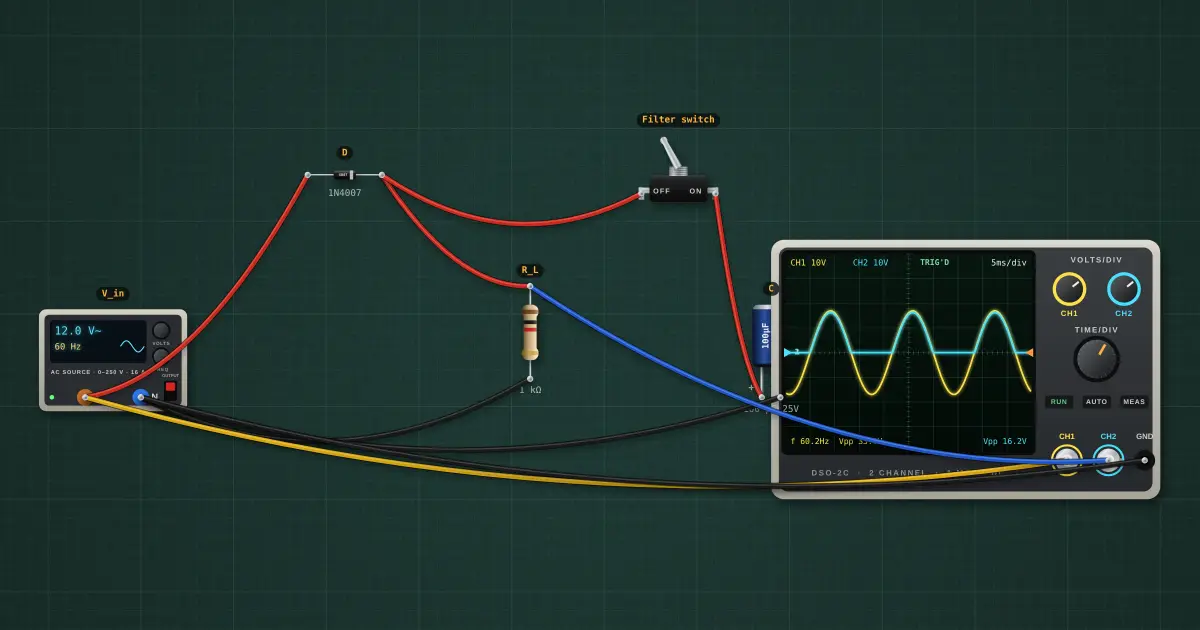
One diode lets only the positive half-cycles through, turning AC into pulsing DC. A reservoir capacitor charges on each peak and feeds the load between them, leaving a ripple of about I / (f·C).
Open this lesson in the labFree, in your browser, no account needed.
How it works
Input peak = 12 × √2 = 16.97 V. Output peak = Vpk − VF ≈ 16.21 V
Average (what a DC meter shows) ≈ (Vpk − VF) / π = 5.05 V, only 42 % of the RMS input, with deep gaps every other half-cycle.
Try it on the bench
- Close the filter switch: the gaps fill in and the output becomes a sawtooth near the peak.
- Change C to 1000 µF: the ripple shrinks about tenfold.
- Lower R_L to 220 Ω: more load current, so more ripple.
Parts on the bench
In the course
Zen’s Electronics Design Mastery, module “Diodes & Power Supplies”.