Zener shunt regulator
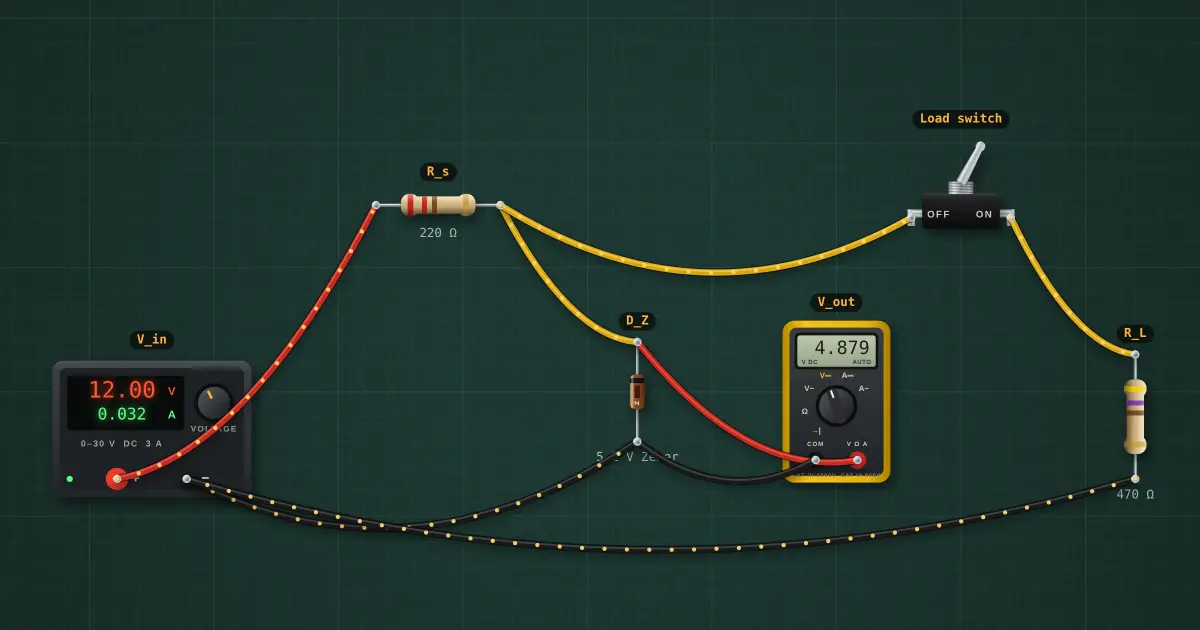
A Zener diode is built to break down in reverse at a precise voltage. With a series resistor it holds the output almost constant: the resistor drops the excess, and the Zener soaks up whatever current the load does not take.
Open this lesson in the labFree, in your browser, no account needed.
How it works
IR = (Vin − VZ) / Rs = (12 − 4.88) / 220 Ω = 32.37 mA
IZ = IR − IL = 32.37 mA − 10.38 mA = 21.99 mA
The 1N4733A has 7 Ω of dynamic resistance, so Vout moves only a little as IZ changes. It stops regulating if the load needs more than IR: RL must stay above VZ·Rs/(Vin − VZ) = 163 Ω.
Try it on the bench
- Change V_in from 9 V to 15 V: the output moves only a few tenths of a volt.
- Open the load switch: all of I_R now flows through the Zener, and its power rises.
- Set R_L to 100 Ω: the load wants more than R_s can pass, so the output drops out of regulation.
Parts on the bench
- Bench power supply
- 2 × Resistor
- Zener diode
- Digital multimeter
- Toggle switch
In the course
Zen’s Electronics Design Mastery, module “Diodes & Power Supplies”.