Voltage doubler and Cockcroft–Walton multiplier
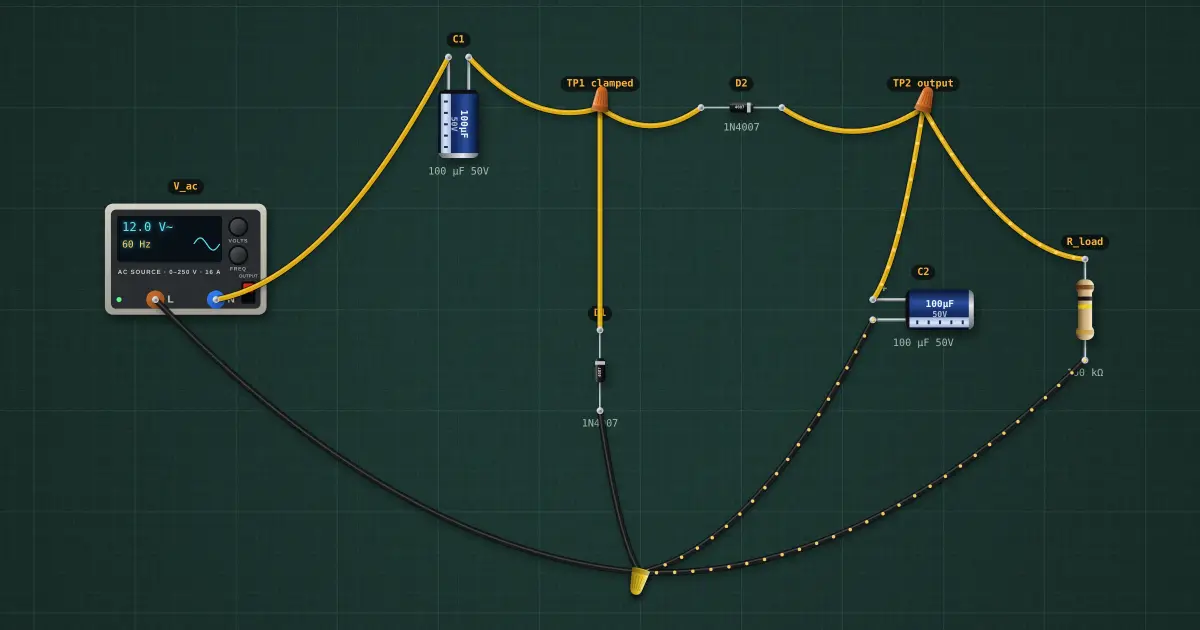
C1 and D1 clamp the AC so it swings from 0 to twice its peak; D2 and C2 then catch that peak. Stack more of these diode-capacitor stages and you get 4×, 6×, 8× the peak: high voltage from low-voltage AC, with no transformer windings.
Open this lesson in the labFree, in your browser, no account needed.
How it works
Peak V_p = 16.97 V. With almost no load each stage adds 2·V_p minus its two diode drops:
V_out ≈ 2·V_p − 2·V_F = 32.7 V
Under load each stage droops by about I ÷ (f·C) per capacitor in the chain, so multipliers suit high voltage at tiny current.
Try it on the bench
- Change R_load to 4.7 kΩ: the output sags well below 2 × peak.
Parts on the bench
- AC source
- 2 × Electrolytic capacitor
- 2 × Rectifier diode
- Resistor
In the course
Electronics Engineering, module “Diodes and supplies”.