Peak and envelope detector
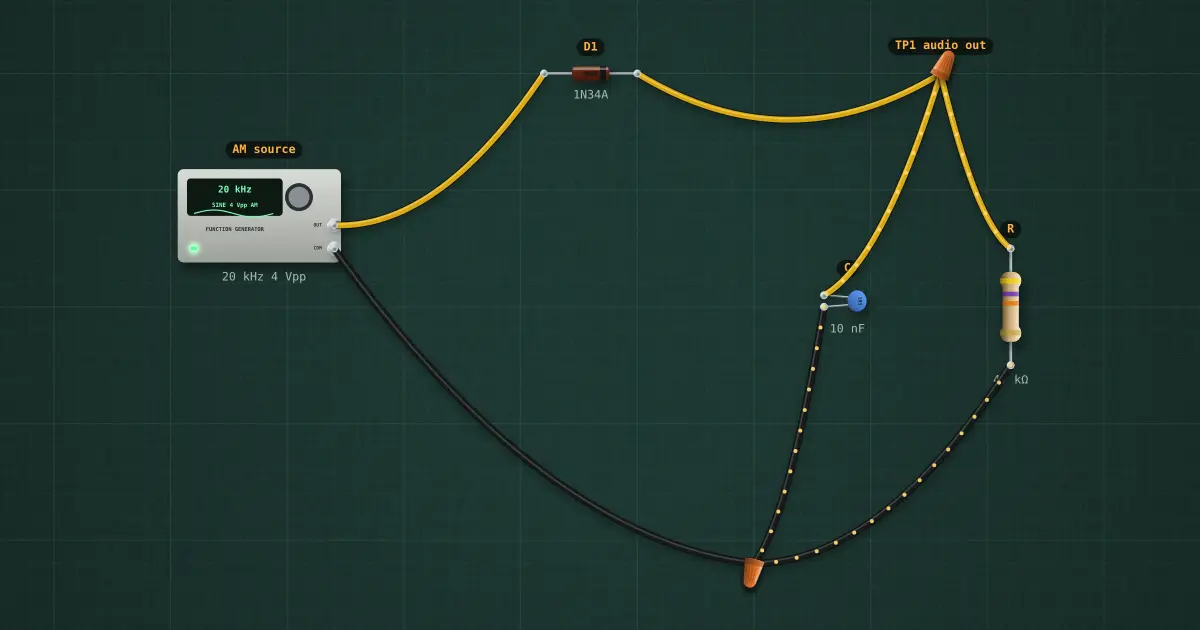
An AM signal is a fast carrier whose amplitude follows the audio. A diode passes the positive peaks and an RC holds them: fast enough to follow the audio, slow enough to ignore the carrier. What is left is the original 500 Hz tone.
Open this lesson in the labFree, in your browser, no account needed.
How it works
R·C = 470 µs: much longer than one carrier cycle (50 µs) and shorter than one audio cycle (2 ms).
To follow the troughs without clipping, R·C < √(1 − m²) ÷ (2π·f_audio·m) = 551 µs.
The output carries the 500 Hz tone.
Try it on the bench
- Change C to 100 nF and watch the troughs.
- Change the modulation tone to 1 kHz: the output follows.
Parts on the bench
In the course
Electronics Engineering, module “Op-amps and feedback”.