Home › Lessons › Power, transformers and three-phase › Opto-isolated mains switching (zero-cross SSR)
Opto-isolated mains switching (zero-cross SSR)
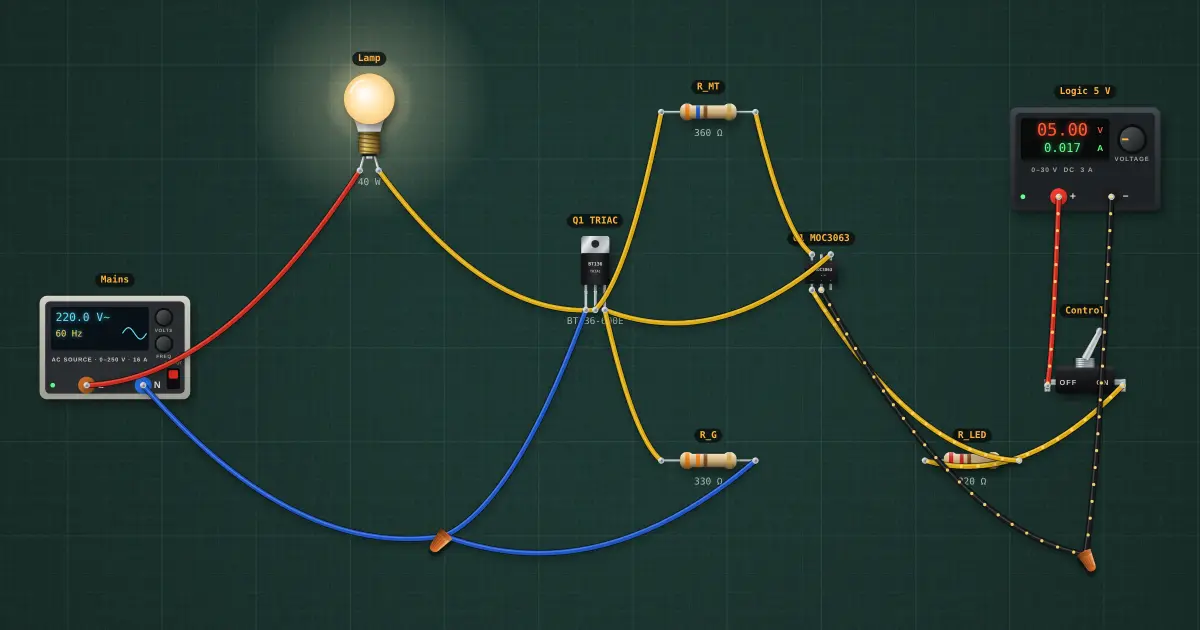
A 5 V signal switches a 220 V lamp with no electrical connection between them. The MOC3063’s LED fires a light-activated TRIAC inside, which triggers the power TRIAC — but only when the mains voltage is near zero, so the lamp starts without a current spike or radio noise.
Open this lesson in the labFree, in your browser, no account needed.
How it works
The LED needs 5 mA; from 5 V through 220 Ω it gets 17 mA. The MOC3063 only fires its output while the mains is within ±20 V of zero.
Once on, the lamp gets the full sine: I = 220 V ÷ 1.21 kΩ = 182 mA RMS.
Try it on the bench
- Toggle the control switch a few times and compare the turn-on voltages.
Parts on the bench
- AC source
- 220 V bulb
- TRIAC
- Opto-TRIAC driver
- 3 × Resistor
- Bench power supply
- Toggle switch
In the course
Embedded & IoT, module “Actuators”.