USB Power Delivery: asking for 20 V
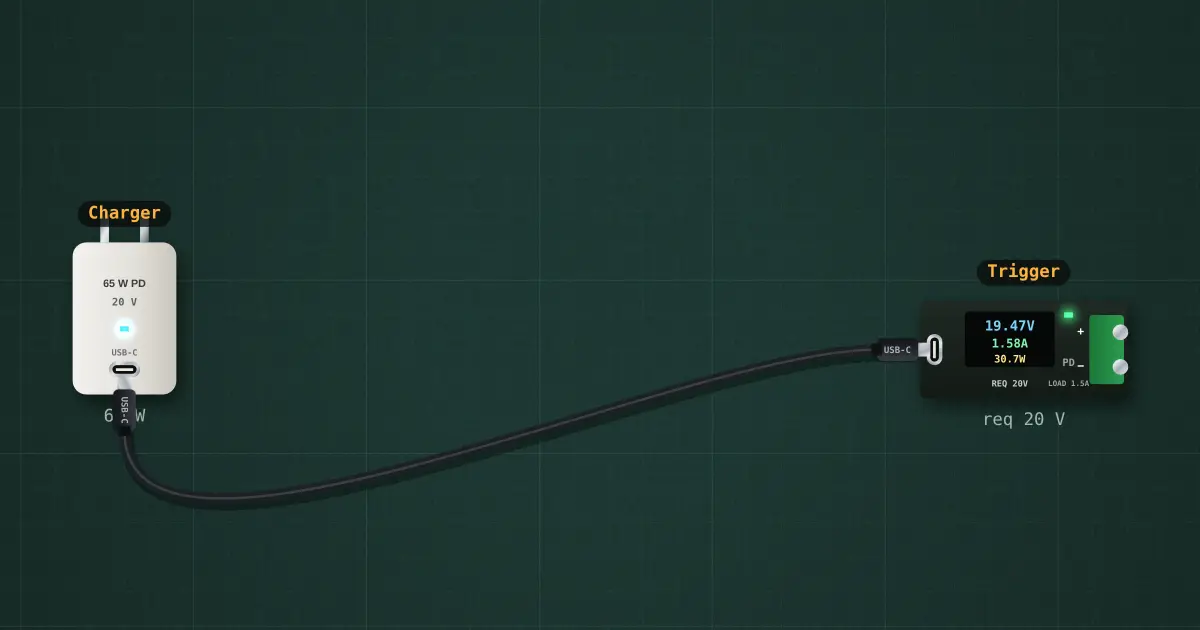
After attach, a PD charger lists the voltages it can supply (Source_Capabilities) over the CC wire. The sink requests one, the charger accepts and ramps VBUS. Higher voltage carries the same power with less current, so less is lost in the cable.
Open this lesson in the labFree, in your browser, no account needed.
How it works
Charger offers: #1 5 V 3 A, #2 9 V 3 A, #3 15 V 3 A, #4 20 V 3.25 A.
Trigger requests 20 V → waiting for attach.
The same 0 W at 5 V would need 0 A; at 0.0 V it needs 0 A. Cable loss goes as I², so much less at the higher voltage.
Try it on the bench
- Select the Trigger and request 12 V: this 65 W charger has no 12 V PDO, so it offers 9 V and the trigger refuses to switch its output on.
- Change the charger to 20 W (5/9/12 V): now 12 V works.
- Unplug the C → C cable and use a USB charger with a USB-A → C cable: no CC wire, no PD, 5 V only.
Parts on the bench
In the course
Zen’s Electronics Design Mastery, module “Capstone — Connected Tracker”.