USB cable voltage drop
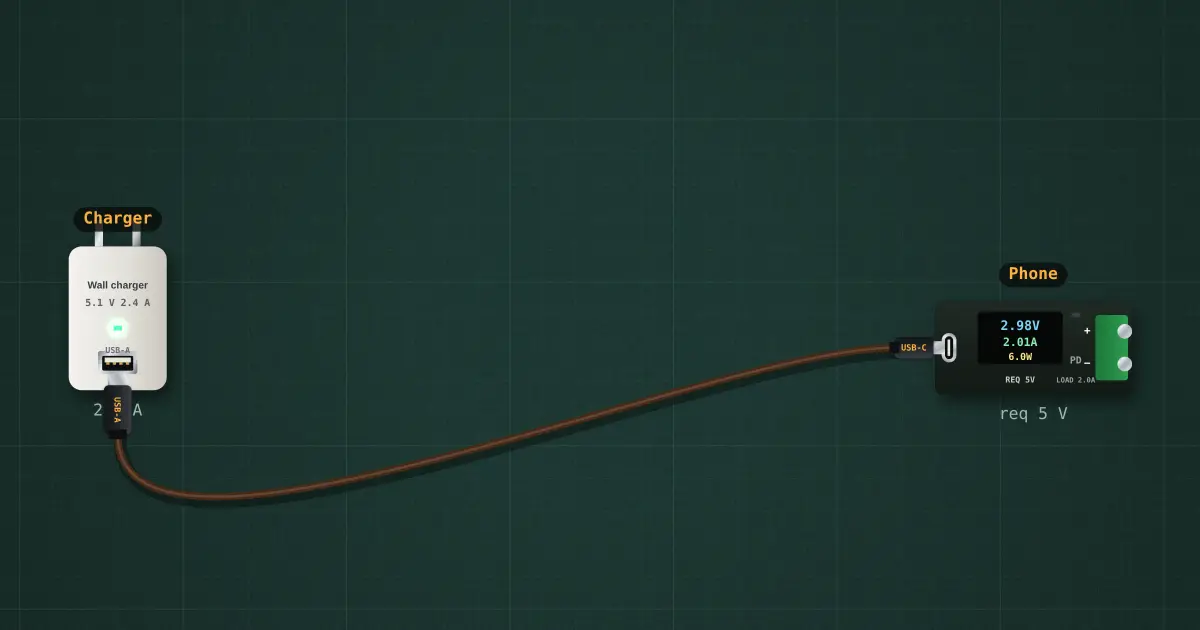
A USB cable is two thin copper wires (VBUS and GND) plus contacts. At charging currents their resistance drops a surprising amount of voltage: that is why a long, thin cable charges slowly. The phone sees a low VBUS and backs off its current.
Open this lesson in the labFree, in your browser, no account needed.
How it works
Each conductor: 2 m × 0.213 Ω/m + 2 contacts × 30 mΩ = 486 mΩ. VBUS and GND together: R = 972 mΩ
V_device = V_charger − I × R = 0 V − 0 A × 972 mΩ = 0 V
Heat in the cable: I²R = 0 W. A phone that needs 4.5 V or more would cut its charging current until VBUS recovers.
Try it on the bench
- Select the cable and change it to 20 AWG, 0.5 m: the phone gets almost the full 5 V.
- Raise the Phone load to 2.4 A: the charger hits its current limit and its own voltage drops too.
- Swap the charger to “Laptop USB 2.0 port”: only 0.5 A is available, so a 2 A load collapses VBUS.
Parts on the bench
In the course
Zen’s Electronics Design Mastery, module “Capstone — Connected Tracker”.