microSD card module (AMS1117, 74LVC125A, FAT32)
Micro SD Card Adapter (AMS1117 + 74LVC125A, 5 V) · 16 GB microSDHC (FAT32)
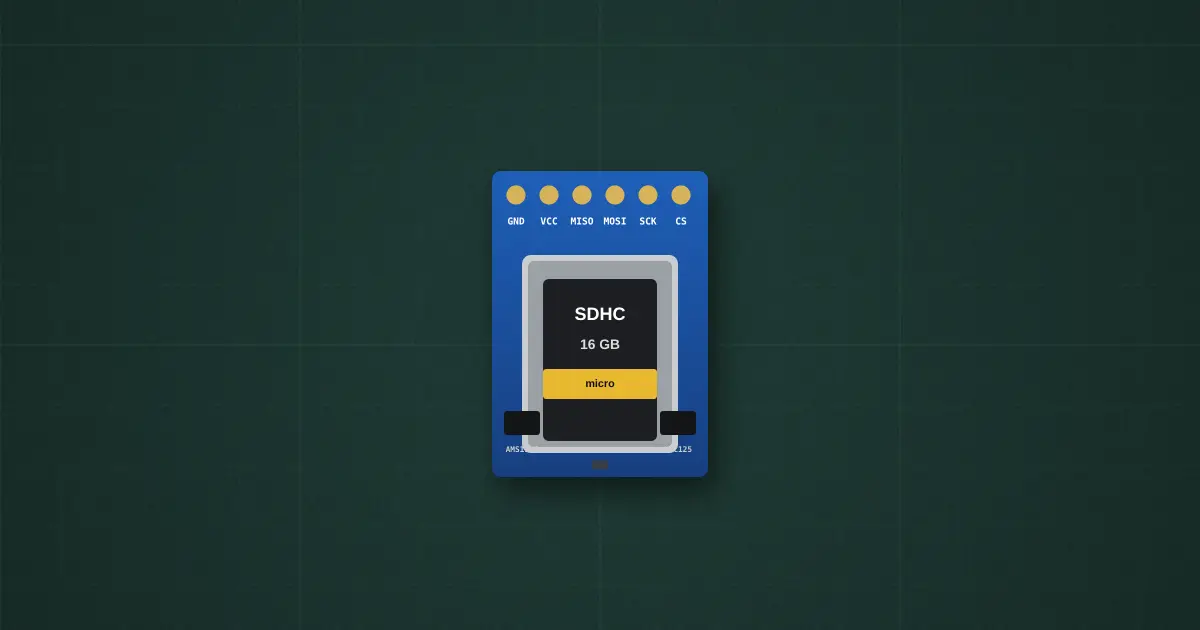
Try it on the benchThe lab drops it on an empty bench and opens its datasheet card.
Typical part: Micro SD Card Adapter (catalex-style, 6-pin) · or a bare 3.3 V microSD breakout
Pins
- GND
- VCC (4.5–5.5 V on this module: it has a 3.3 V regulator)
- MISO (card DO → MCU)
- MOSI (MCU → card DI)
- SCK
- CS (chip select, active LOW)
Ratings and limits
| Supply | 5 V module: VCC 4.5–5.5 V into an AMS1117-3.3 (drops about 1.1 V, so 3.3 V in leaves the card about 2.2 V: not enough). Bare breakout: 3.3 V only, no regulator, 5 V kills the card |
|---|---|
| Current | card idle about 0.3 mA, 30–100 mA while writing (peaks up to 200 mA on some cards): give it a solid supply and a 10 µF cap near the socket |
| Bus | SPI mode 0, up to 25 MHz (4 MHz is the SD.h default); the card needs at least 74 clocks with CS high before CMD0 |
| Level shifter | the 5 V module’s 74LVC125A has its output enable tied low: MISO is driven even when CS is high, so it blocks other SPI devices on the same MISO. Give it its own SPI bus, or use a module with a proper tri-state buffer |
| Cards | SDSC up to 2 GB (FAT16), SDHC 4–32 GB (FAT32). 64 GB and larger SDXC cards come formatted exFAT, which the ESP32 SD library cannot mount: reformat them as FAT32 |
| Pull-ups | MISO, MOSI and CS want 10 kΩ pull-ups; most modules fit them |
How to use it
A data logger’s storage. With SD.h: SD.begin(CS) mounts the card, SD.open("/log.csv", FILE_APPEND) opens a file, print/println write, close() (or flush()) makes it permanent. Paths start with "/". FILE_WRITE on the ESP32 starts the file empty; FILE_APPEND adds to the end.
More in microcontrollers & modules
- Arduino Uno R3
- Arduino Nano
- ESP32 DevKit
- ESP32-S3 DevKitC-1
- Raspberry Pi Pico 2
- LILYGO T-SIM A7670E R2
- Orange Pi One
- Coin acceptor
- Coin slot (₱5 only)
- I2C LCD
Sources: SD Association Physical Layer Simplified Specification v9 (SPI mode, CMD0/8/55/41/58, CSD v1/v2); Espressif arduino-esp32 SD library (sd_diskio.cpp, vfs_api.cpp); ChaN FatFs; AMS1117 and 74LVC125A datasheets.