High-side current sensing
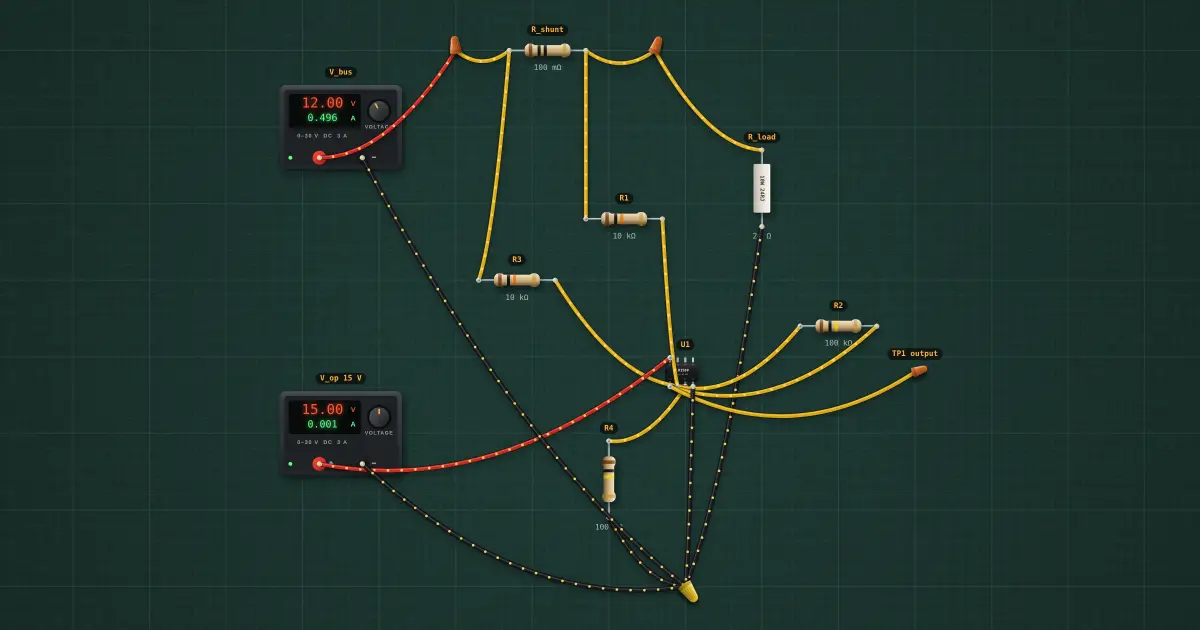
Measure the current into a 12 V load without breaking its ground: a 0.1 Ω shunt in the supply lead, and a difference amplifier that subtracts the two ends of the shunt, ignores the 12 V they share, and amplifies the tiny difference ten times. 1 A → 1 V.
Open this lesson in the labFree, in your browser, no account needed.
How it works
I = 12 ÷ 24.1 Ω = 498 mA; the shunt drops 49.8 mV on top of 11.95 V common-mode.
V_out = (R2 ÷ R1)·(V_a − V_b) = 10 × 49.8 mV = 498 mV.
R3 and R1 connect right at the shunt’s own terminals (a Kelvin connection): the few milliohms of the wires carrying the load current would otherwise add to the 0.1 Ω.
Inputs sit at 12 × 100k ÷ 110k ≈ 10.9 V: inside the LM358’s range only because its own supply is 15 V.
Try it on the bench
- Change R_load to 12 Ω: 1 A → 1 V.
Parts on the bench
In the course
Electronics Engineering, module “Op-amps and feedback”.