Instrumentation amplifier
Sensors like strain gauges give a few millivolts of difference riding on a few volts of common-mode voltage. An instrumentation amplifier amplifies only the difference, with a high input impedance on both inputs. Two followers with a shared gain resistor R_G set the gain; a difference amplifier rejects the common-mode voltage.
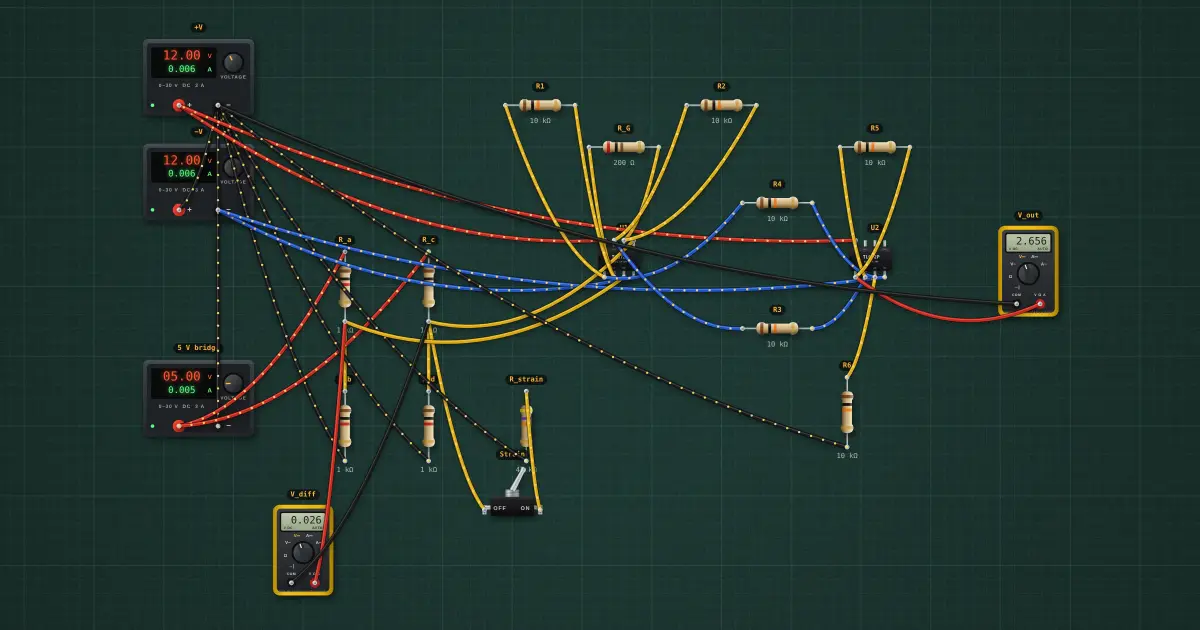
Open this lesson in the labFree, in your browser, no account needed.
How it works
Bridge: VA = 2.5 V, VB = 2.474 V → difference 26.3 mV on a common-mode level of 2.487 V
Gain G = (1 + 2R1/RG) × R5/R3 = (1 + 2 × 10 kΩ / 200 Ω) × 1 = 101
Vout = G × (VA − VB) = 2.658 V. The 2.5 V common to both inputs does not appear at the output. Chips like the INA128 or AD620 put all three op-amps and matched resistors in one package, needing only RG.
Try it on the bench
- Flip the Strain switch off: the bridge balances and the output falls to about 0 V, even though both inputs still sit near 2.5 V.
- Change R_G to 1 kΩ: the gain drops from 101 to 21.
- Change R6 alone to 12 kΩ: the difference stage is now mismatched and some of the common-mode voltage leaks into the output.
Parts on the bench
- 3 × Bench power supply
- 12 × Resistor
- Toggle switch
- 2 × Op-amp
- 2 × Digital multimeter
In the course
Zen’s Electronics Design Mastery, module “Op-Amps & Analog ICs”.