Negative feedback and stability
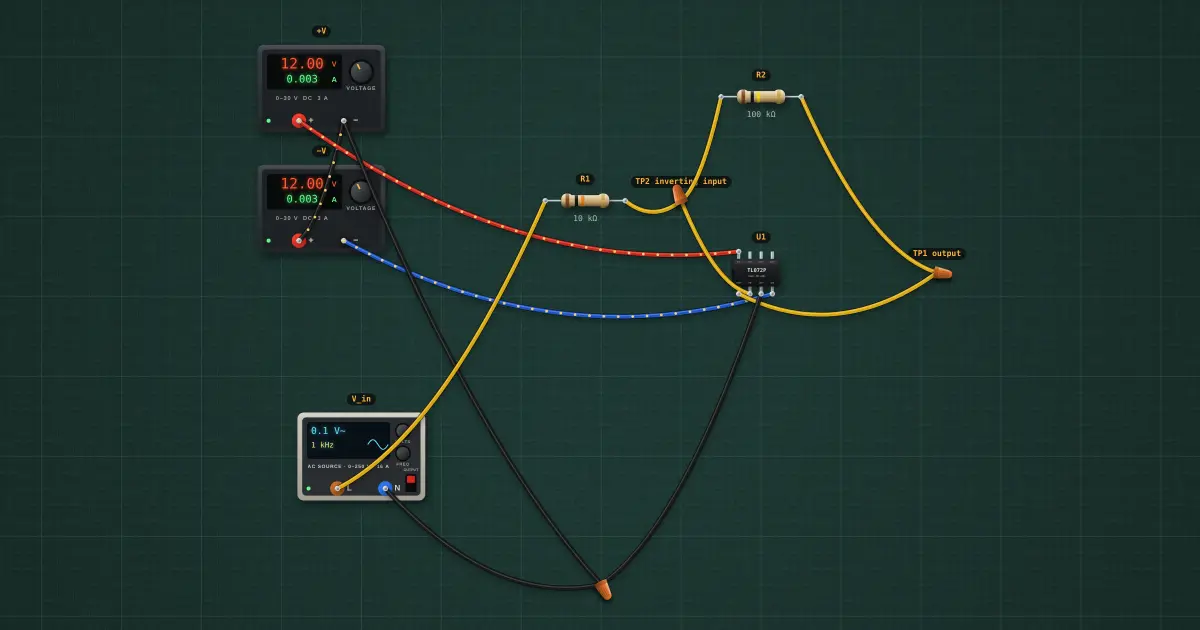
An op-amp has a huge, unreliable open-loop gain A. Feed back a fraction β of the output and the closed-loop gain becomes A ÷ (1 + Aβ) ≈ 1 ÷ β: set by two resistors, not by the chip. The same loop, wired the other way (positive feedback), runs away to a rail and stays there.
Open this lesson in the labFree, in your browser, no account needed.
How it works
β = R1 ÷ (R1 + R2) = 0.0909; with A = 200k the loop gain Aβ = 18182.
Closed-loop gain = −(R2 ÷ R1) ÷ (1 + 1 ÷ Aβ) = -9.9995: within 0.005 % of −10. Even if A halves, the gain hardly moves: that is what feedback buys.
The inverting input moves only V_out ÷ A ≈ 7.1 µV: a virtual ground.
Try it on the bench
- Change R2 to 47 kΩ: gain 4.7.
Parts on the bench
In the course
Electronics Engineering, module “Op-amps and feedback”.