Neon-lamp relaxation oscillator
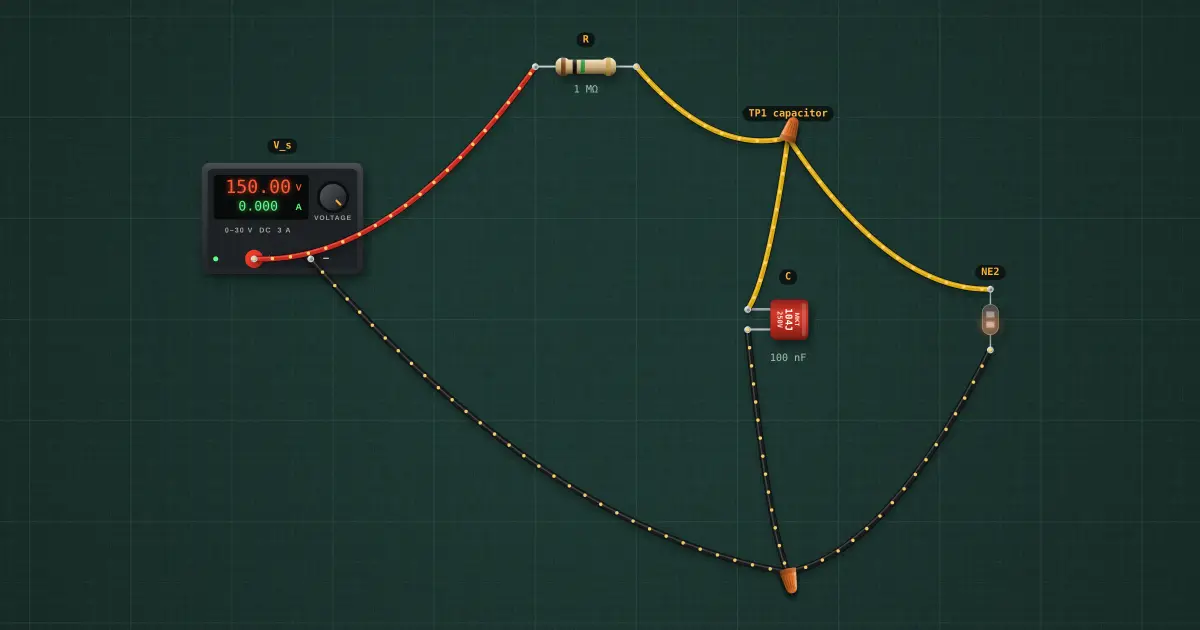
The capacitor charges through a large resistor. At about 90 V the neon gas ionises, the lamp flashes and drains the capacitor down to about 60 V, where the glow goes out. Then it charges again: a flasher with one lamp, one resistor and one capacitor.
Open this lesson in the labFree, in your browser, no account needed.
How it works
The capacitor swings between the maintaining voltage (60 V) and the striking voltage (90 V):
T = R·C·ln((V − 60) ÷ (V − 90)), f = 24.7 Hz
It only oscillates if the resistor cannot keep the lamp lit: (V − 60) ÷ R must be below the lamp’s extinction current.
Try it on the bench
- Lower the supply to 100 V: the flashes slow right down.
- Change R to 220 kΩ: now the resistor can keep the lamp lit, so it glows steadily instead of flashing.
Parts on the bench
- Bench power supply
- Resistor
- Film capacitor
- Neon lamp
In the course
Electronics Fundamentals, module “Switching with transistors”.