RC phase-shift oscillator
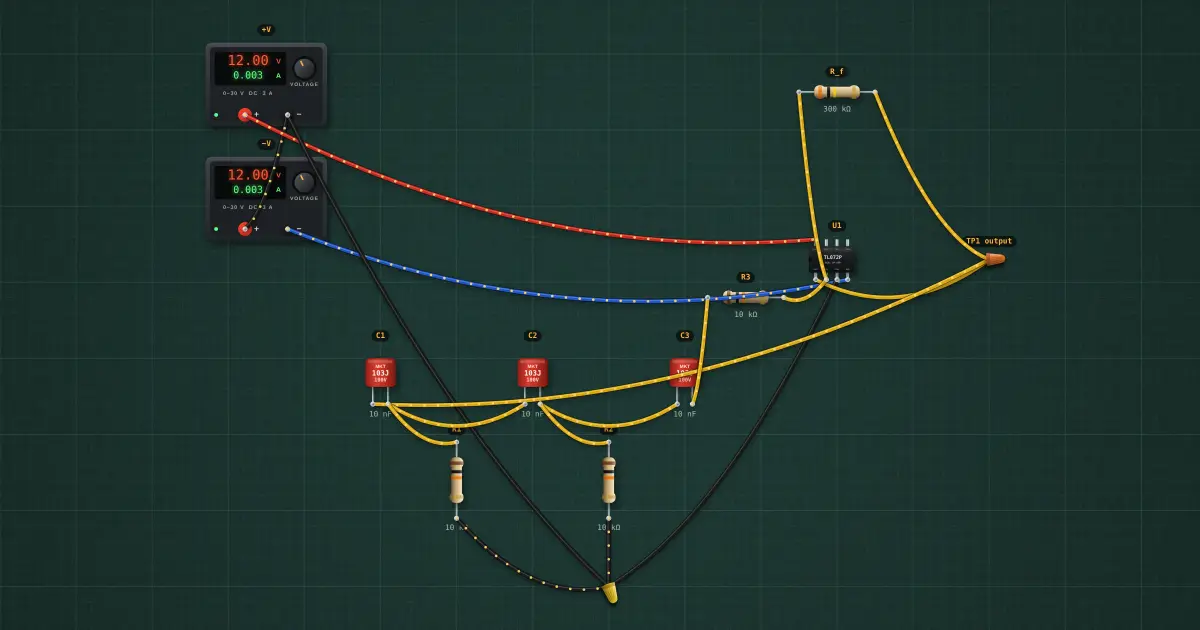
Three RC sections each delay the signal; at one frequency they add up to 180°. An inverting amplifier adds the other 180°, so the loop is positive feedback at exactly that frequency and the circuit rings into a steady sine.
Open this lesson in the labFree, in your browser, no account needed.
How it works
For three equal sections fed from the output, the loop phase is 180° at
f = 1 ÷ (2π · R · C · √6) = 650 Hz
where the network passes 1/29 of the signal, so the amplifier needs a gain above 29: here R_f ÷ R3 = 30.
Try it on the bench
- Reduce R_f to 270 kΩ (gain 27): the oscillation dies away, because the loop gain is below 1.
- Double all three capacitors: the frequency halves.
Parts on the bench
- 2 × Bench power supply
- Op-amp
- 3 × Film capacitor
- 4 × Resistor
In the course
Electronics Engineering, module “Oscillators and timing”.