Op-amp relaxation oscillator
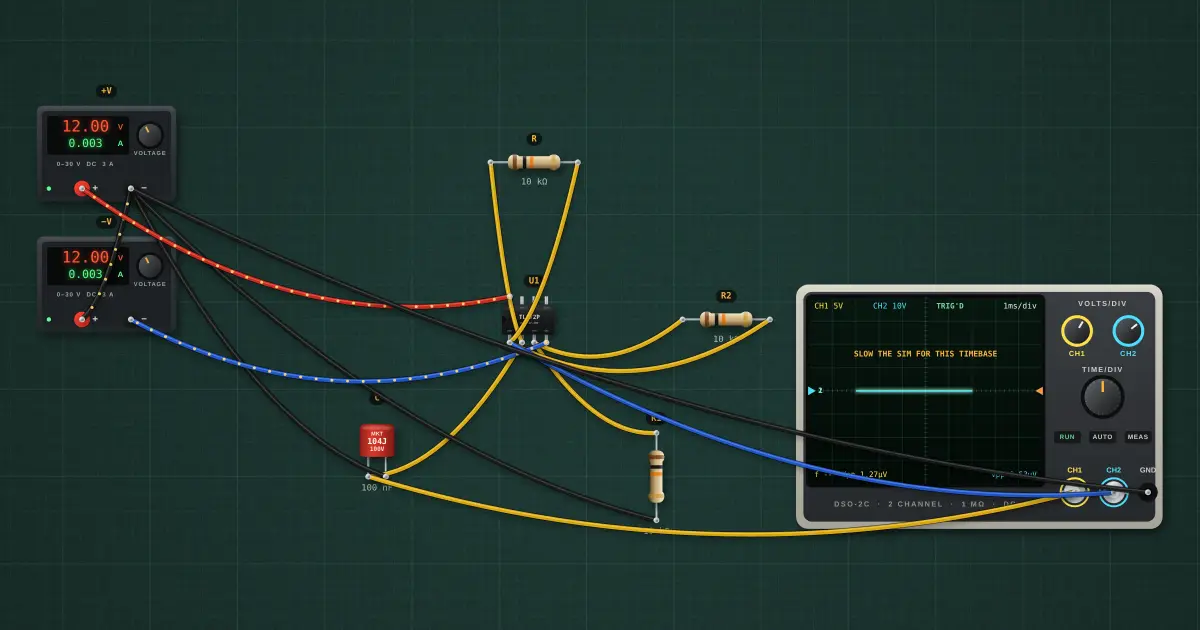
A Schmitt trigger whose own output charges a capacitor on IN− through R. When the capacitor reaches a threshold the output flips and starts charging it the other way, giving a square wave: f = 1 / (2RC · ln((1+β)/(1−β))).
Open this lesson in the labFree, in your browser, no account needed.
How it works
β = R1/(R1+R2) = 0.500
T = 2RC · ln((1+β)/(1−β)) = 2 × 1 ms × 1.099 = 2.2 ms
f = 455.1 Hz, about 50 % duty
Try it on the bench
- Double C to 220 nF: the frequency halves.
- Change R2 to 47 kΩ: the thresholds close in and it speeds up.
Parts on the bench
- 2 × Bench power supply
- Op-amp
- 3 × Resistor
- Film capacitor
- Oscilloscope
In the course
Zen’s Electronics Design Mastery, module “Op-Amps & Analog ICs”.