Astable multivibrator (two transistors)
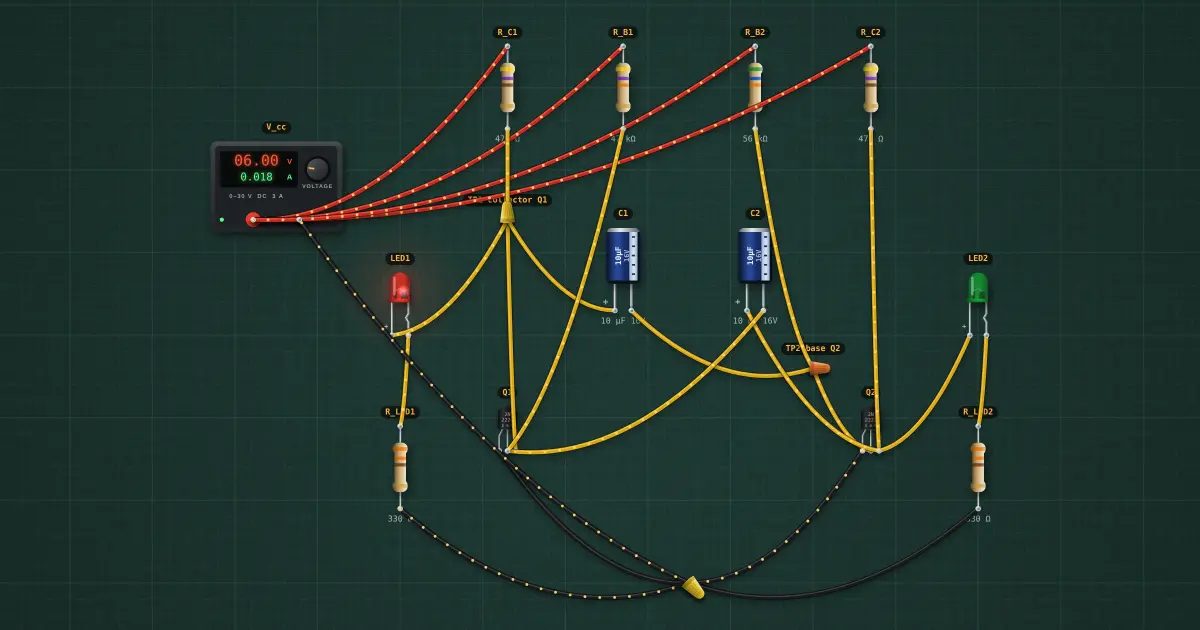
Two transistors take turns: when one switches on, its collector drops and the capacitor kicks the other one off until that capacitor recharges through its base resistor. Each LED hangs from a collector, so it lights while its transistor is off: they flash alternately with no IC at all.
Open this lesson in the labFree, in your browser, no account needed.
How it works
The off transistor’s collector rises to V_H ≈ (V_cc·R_LED + V_F·R_C) ÷ (R_LED + R_C) ≈ 3.55 V (the LED branch loads it). That step, coupled through the capacitor, drives the other base down by the same amount.
The base starts at about 0.75 − ΔV and charges through R_B towards V_cc until the transistor turns on near 0.6 V: t = R_B·C·ln((V_cc + ΔV − 0.75) ÷ (V_cc − 0.6)). With a full swing (no LED load) that is close to the textbook 0.693·R_B·C.
f = 1.98 Hz
Try it on the bench
- Change both capacitors to 47 µF: it slows to about a fifth.
- Make R_B1 and R_B2 very different: the duty cycle becomes uneven.
Parts on the bench
- Bench power supply
- 6 × Resistor
- 2 × LED
- 2 × Electrolytic capacitor
- 2 × NPN transistor
In the course
Electronics Fundamentals, module “Switching with transistors”.