UJT relaxation oscillator
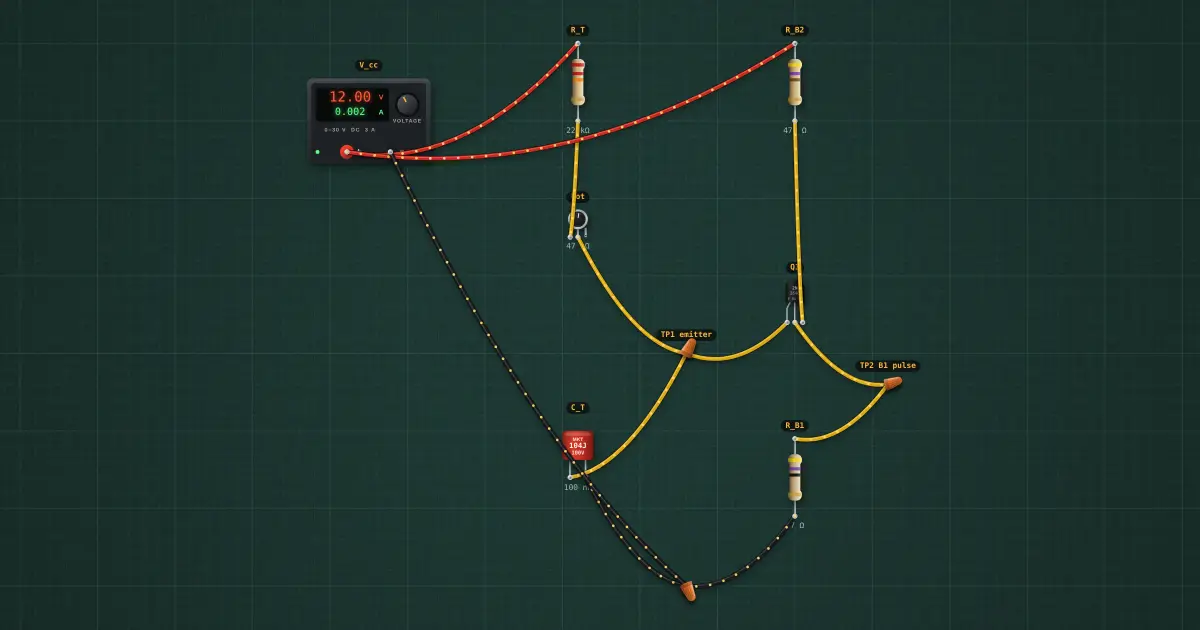
A capacitor charges through a resistor until the emitter of the unijunction transistor reaches its peak-point voltage (η·V_BB + 0.5 V). The UJT then fires and dumps the capacitor through B1, producing a sharp pulse, and the cycle starts again.
Open this lesson in the labFree, in your browser, no account needed.
How it works
Peak point V_P ≈ η·V_BB + 0.5 V = 7.47 V; after firing the capacitor falls to about 1 V.
t = R·C·ln((V − V_v) ÷ (V − V_P)), so f ≈ 240 Hz (R = 46.9 kΩ). The textbook shortcut f ≈ 1 ÷ (R·C·ln(1/(1−η))) gives 220 Hz.
Try it on the bench
- Turn the pot: the rate changes smoothly, because only the charging time depends on R.
- Make R_T + pot too small (under about 2 kΩ): the supply alone holds the emitter above the valley current and it latches on instead of oscillating.
Parts on the bench
- Bench power supply
- 3 × Resistor
- Potentiometer
- Film capacitor
- UJT (unijunction)
In the course
Electronics Technician, module “Op-amps and timers”.