Wien-bridge oscillator with lamp stabiliser
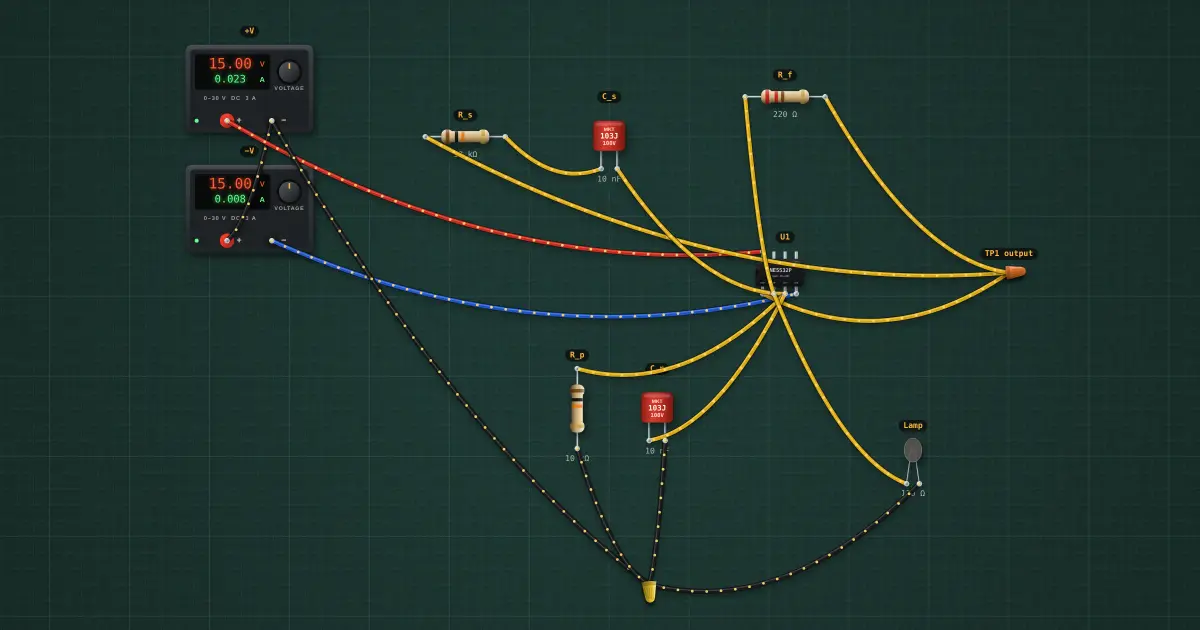
A series RC and a parallel RC pass exactly one third of the signal, in phase, at f = 1/(2πRC). A non-inverting amplifier with a gain of 3 sustains it. The trick is the lamp: as the amplitude grows it heats up, its resistance rises and the gain drops back to exactly 3, so the sine stays clean.
Open this lesson in the labFree, in your browser, no account needed.
How it works
At f = 1 ÷ (2πRC) = 1.592 kHz the Wien network passes exactly ⅓ with zero phase shift.
The loop gain is 1 when 1 + R_f ÷ R_lamp = 3, so the lamp settles at R_f ÷ 2 = 110 Ω.
Try it on the bench
- Replace the lamp with a fixed 110 Ω resistor: the output either dies or grows into a clipped square wave, because a fixed gain is never exactly 3.
- Change both capacitors to 4.7 nF: about 3.4 kHz.
Parts on the bench
- 2 × Bench power supply
- NE5532 low-noise op-amp
- 3 × Resistor
- 2 × Film capacitor
- Pilot lamp
In the course
Electronics Engineering, module “Oscillators and timing”.