Colpitts and Hartley LC oscillators
An LC tank rings at its resonant frequency. A transistor tops up the energy lost each cycle: in the Colpitts the feedback is taken from a capacitive divider across the tank, in the Hartley from a tapped coil.
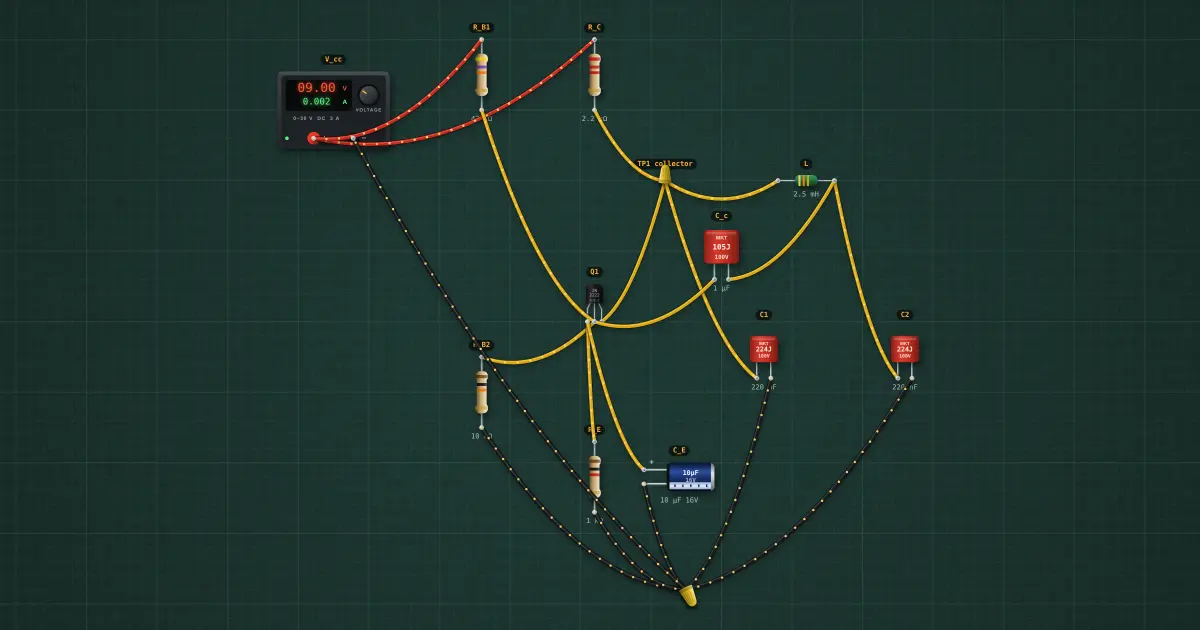
Open this lesson in the labFree, in your browser, no account needed.
How it works
The tank is L with C1 and C2 in series: C = 110 nF.
f = 1 ÷ (2π√(L·C)) = 9.6 kHz
The feedback fraction is C1 ÷ C2; the transistor’s gain must exceed C2 ÷ C1 = 1.0.
Try it on the bench
- Halve the coil to 1 mH: the frequency rises by √2.5 ≈ 1.6×.
- Make C1 much bigger than C2: less feedback, and below the gain threshold it stops.
Parts on the bench
- Bench power supply
- 4 × Resistor
- NPN transistor
- Electrolytic capacitor
- Axial choke
- 3 × Film capacitor
In the course
Electronics Engineering, module “Oscillators and timing”.