Crystal oscillator (Pierce)
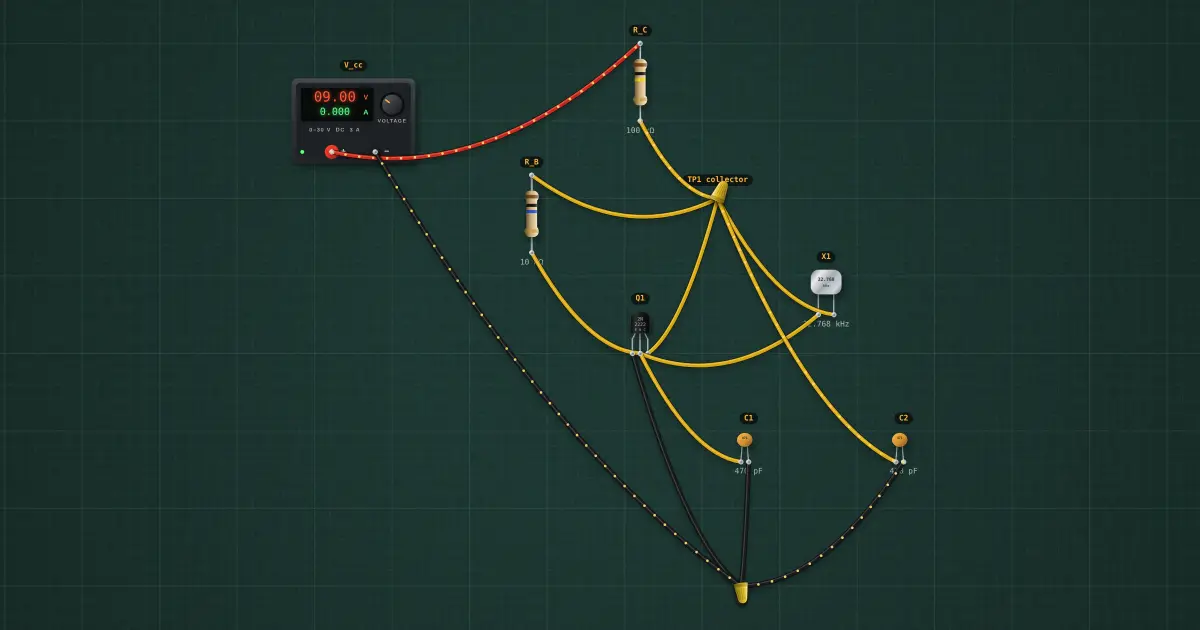
Replace the coil of an LC oscillator with a quartz crystal: it behaves like an extremely sharp tuned circuit, so the oscillation is locked to the crystal’s own frequency, 32.768 kHz here, almost regardless of the transistor or the supply.
Open this lesson in the labFree, in your browser, no account needed.
How it works
The crystal is an electrical model of a vibrating quartz bar: L1 = 97.1 H, C1 = 0 F, R1 = 40 kΩ, with C0 = 1.3 pF across it.
It oscillates where the crystal looks slightly inductive, just above f_s = 1 ÷ (2π√(L1·C1)) = 32.768 kHz.
Simulated with Q = 500 so it starts in tens of milliseconds; real crystals (Q ≈ 50 000) take about a second.
Try it on the bench
- Set the supply to 6 V and then 12 V: the frequency stays within a fraction of a percent.
- Swap the crystal for the 1 MHz one: the circuit follows it.
Parts on the bench
- Bench power supply
- 2 × Resistor
- NPN transistor
- Quartz crystal
- 2 × Ceramic capacitor
In the course
Electronics Engineering, module “Oscillators and timing”.