IRF520 MOSFET module
IRF520 N-channel MOSFET on a module · switches the load's negative side (V−) to GND · up to 24 V · Rds(on) 0.27 Ω with 10 V on the gate; it is not a logic-level MOSFET: with 5 V on SIG it passes about 1 A, with 3.3 V almost nothing · SIG LED · no heatsink, keep it under ~2 W
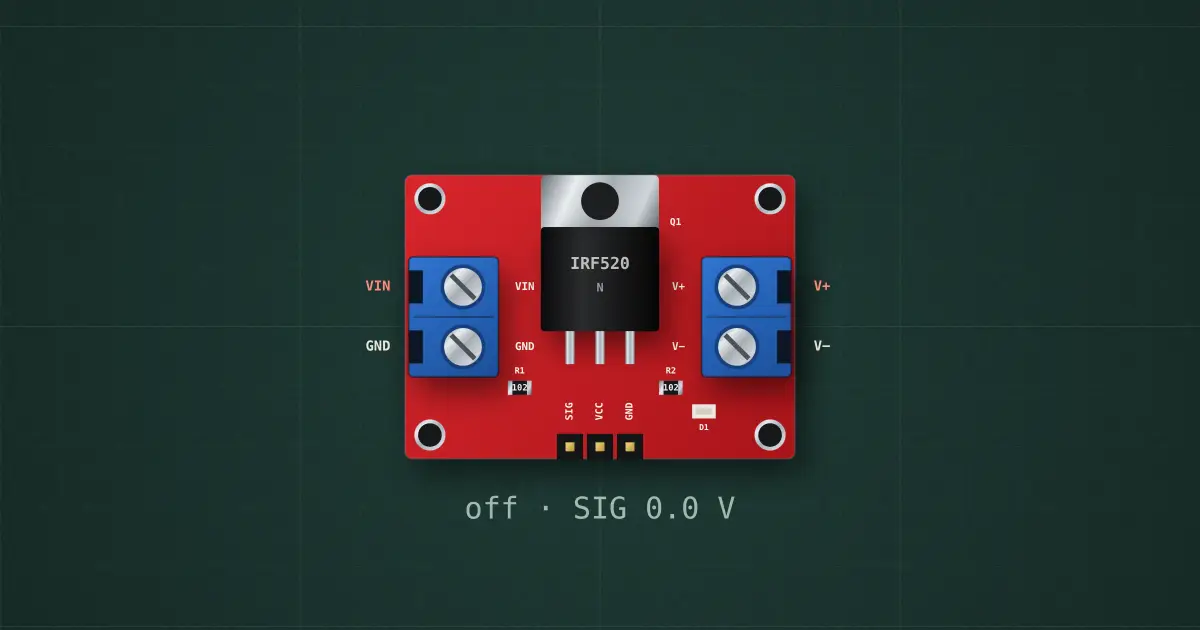
Try it on the benchThe lab drops it on an empty bench and opens its datasheet card.
Pins
- V+ (load +)
- V− (load −)
- VIN (supply +)
- GND (supply −)
- SIG
- VCC (not connected)
- GND
What it is
This red module switches a DC load, such as an LED strip, motor, solenoid or pump, on the low side. The load connects between V+ and V−, the supply between VIN and GND, and the microcontroller drives SIG. The IRF520 MOSFET connects V− to GND when SIG is high, and the LED shows when SIG is high.
What to check before you buy or wire it
- The IRF520 is not a logic-level MOSFET. It needs about 10 V on SIG to switch fully on (0.27 Ω). With 5 V from an Uno it passes only about 1 A, and with 3.3 V from an ESP32 it barely conducts.
- There is no heatsink and no flyback diode on the board. Keep the dissipation under about 2 W, and fit a diode across motors and solenoids.
Common mistakes
- Driving it from a 3.3 V ESP32 and wondering why the load stays off. Use a logic-level MOSFET such as the IRLZ44N, or a transistor that drives the gate with 10 V or more.
- Running a 3 A motor through it at 5 V gate drive: the MOSFET overheats and fails short, so the load stays on.
Where it is used
PWM dimming of LED strips and slow speed control of 12 V fans and pumps, when it is driven by a 5 V board at modest currents.