Darlington pair
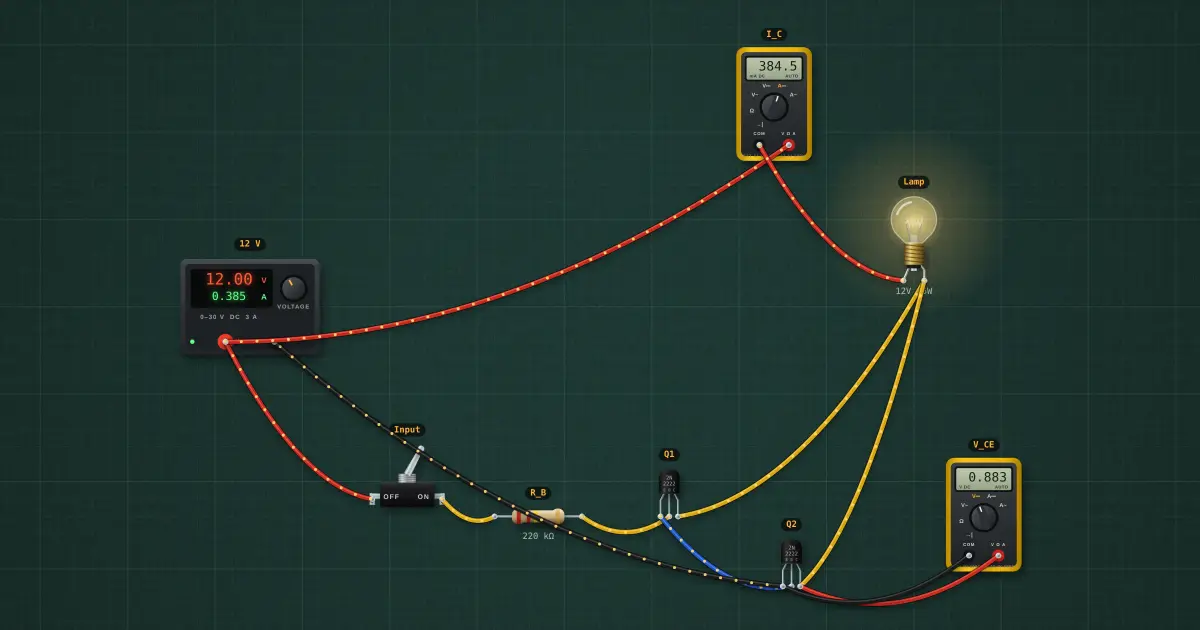
Feed one transistor’s emitter current into a second transistor’s base and the gains multiply: β_total ≈ β1·β2, tens of thousands. A tiny base current can switch an amp. The price is a 1.2–1.4 V base drive and a collector-emitter voltage that never falls below about 0.8 V, so it runs warmer than a single transistor.
Open this lesson in the labFree, in your browser, no account needed.
How it works
βtotal ≈ β·(β+1) + β = 180·181 + 180 ≈ 32,760
IB = (12 − 2·VBE) / RB = (12 − 1.48) / 220 kΩ = 47.8 µA, enough for a 416.7 mA lamp.
Q2 can never saturate: its collector sits at least one VBE plus Q1’s VCE above its emitter, so VCE ≈ 887 mV and the pair dissipates 340 mW. A single saturated 2N2222 drops about 0.1 V.
Try it on the bench
- A 220 kΩ base resistor passes only about 50 µA, yet the lamp is fully on. A single 2N2222 would need about 2 mA.
- Compare V_CE with the “Transistor as a switch” lesson: about 0.8 V here against 0.1 V there.
- Chips like the ULN2003 contain seven Darlingtons for driving relays and stepper motors from logic pins.
Parts on the bench
- Bench power supply
- Toggle switch
- Resistor
- 2 × NPN transistor
- 2 × Digital multimeter
- Incandescent bulb
In the course
Zen’s Electronics Design Mastery, module “Transistors”.