Emitter follower (buffer)
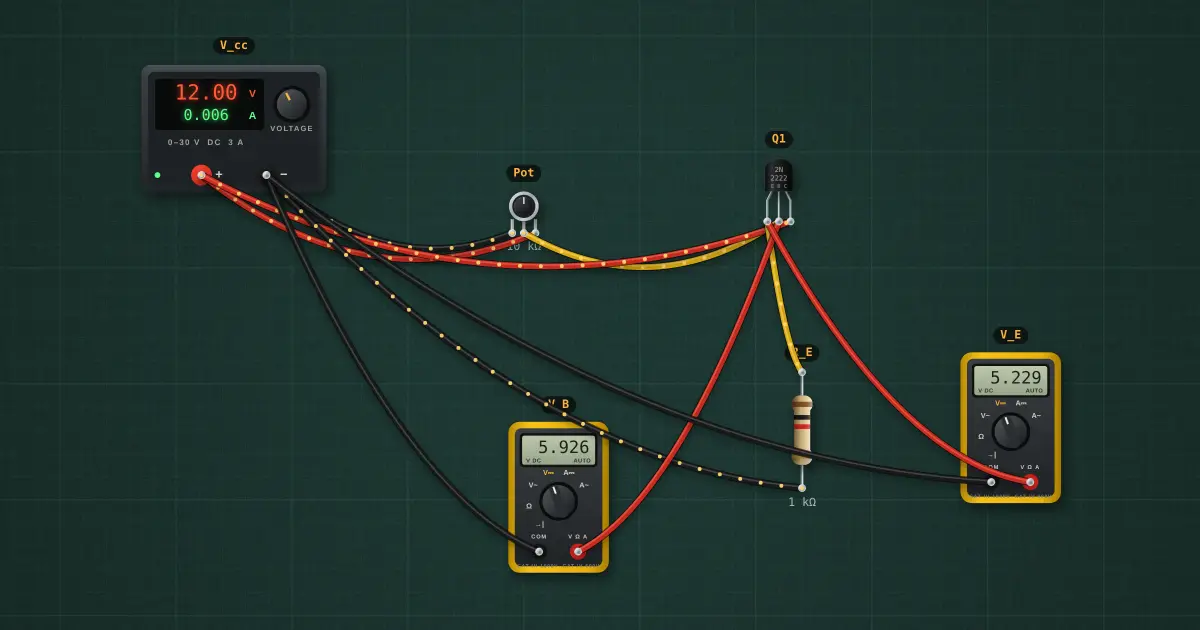
Take the output from the emitter and it follows the base, about 0.65 V lower: gain ≈ 1. The base draws only I_E / (β + 1), so a weak source (here a 10 kΩ pot) can drive a much heavier load.
Open this lesson in the labFree, in your browser, no account needed.
How it works
Unloaded wiper: VCC × position = 6 V, from a source resistance of 2.5 kΩ.
VE = VB − VBE = 5.928 V − 697.4 mV = 5.23 V; IE = VE / RE = 5.23 mA
IB = IE / (β + 1) = 28.9 µA. The pot sees RE multiplied by β + 1 ≈ 181 kΩ, so its voltage barely sags.
Try it on the bench
- Scroll over the pot: V_E tracks V_B, always about 0.65 V below.
- Lower R_E to 100 Ω: the load current rises tenfold, yet V_B hardly moves.
- Turn the pot right down: below about 0.6 V on the base the transistor switches off and V_E falls to 0.
Parts on the bench
- Bench power supply
- Potentiometer
- NPN transistor
- Resistor
- 2 × Digital multimeter
In the course
Zen’s Electronics Design Mastery, module “Transistors”.