Class A, B and AB output stages
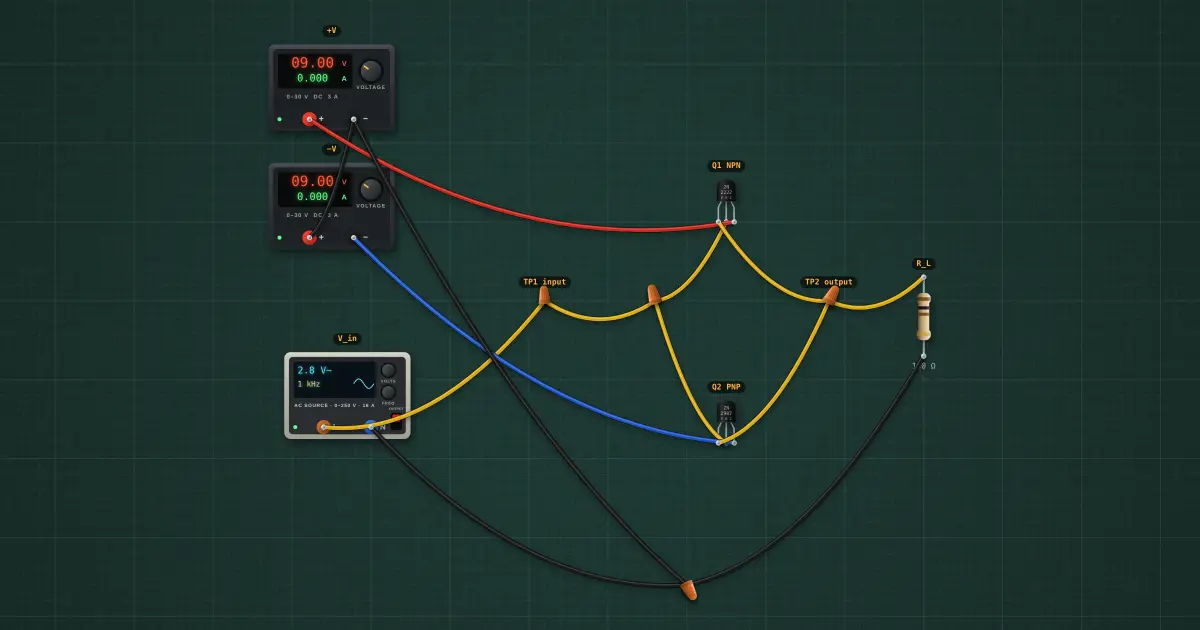
Two emitter followers, an NPN for the positive half and a PNP for the negative half, push and pull the speaker. With the bases tied together (class B) neither conducts for the first 0.65 V either way: the output has a flat step at every zero crossing. Two diodes pre-bias the bases (class AB) and the step disappears.
Open this lesson in the labFree, in your browser, no account needed.
How it works
Class B: each transistor needs V_BE ≈ 0.65 V before it conducts, so the output peak is V_in,peak − 0.65 = 3.35 V and the output sits at 0 V for |V_in| < 0.65 V (crossover distortion).
Efficiency at full swing reaches π/4 ≈ 78 %; class A, which runs current all the time, manages 25 %.
Try it on the bench
- Reduce V_in to 0.5 V peak: class B gives no output at all.
Parts on the bench
- 2 × Bench power supply
- AC source
- NPN transistor
- PNP transistor
- Resistor
In the course
Electronics Engineering, module “Transistor amplifiers”.