BJT current gain (β)
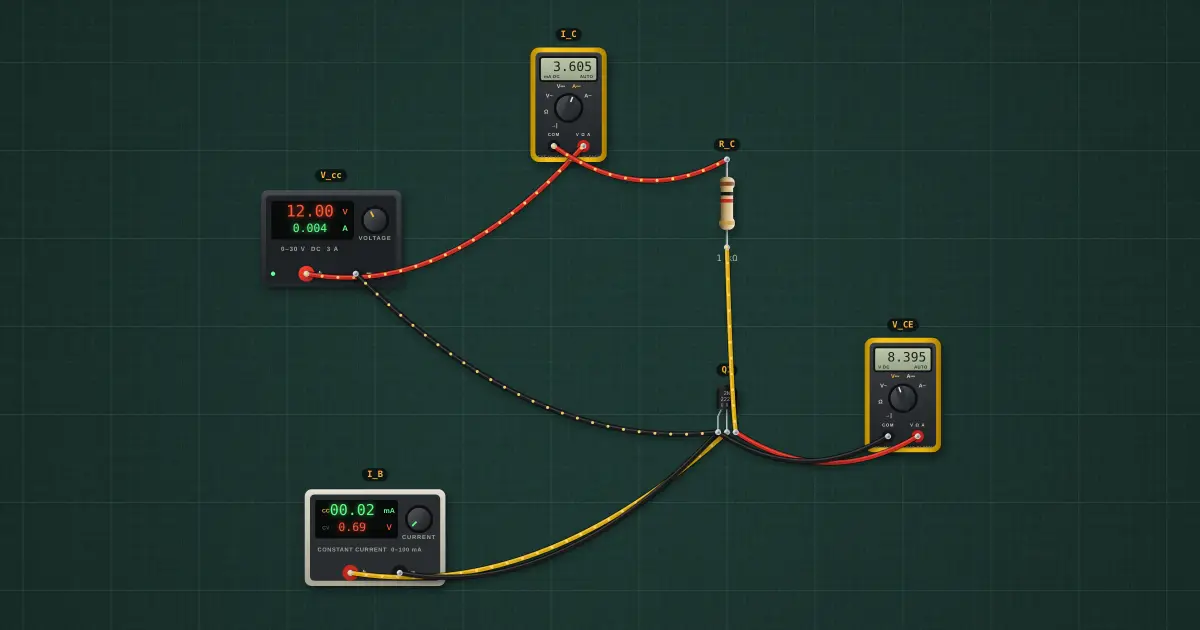
In a bipolar transistor a small base current controls a collector current β times larger: I_C = β · I_B. Here a current source feeds the base, so you can see the gain directly, and see it stop once the collector resistor limits the current (saturation).
Open this lesson in the labFree, in your browser, no account needed.
How it works
β ≈ 180 for this 2N2222. IC = β · IB = 180 × 20 µA = 3.6 mA
VCE = VCC − IC·RC = 8.4 V. The transistor is in its active region, acting as an amplifier.
VBE = 687.9 mV: like any silicon junction, about 0.6–0.7 V.
Try it on the bench
- Set I_B to 10, 20 and 40 µA: I_C follows at 180× each time.
- Set I_B to 100 µA: β × I_B would be 18 mA, but R_C allows only 12 mA. The transistor saturates and V_CE collapses to about 0.1 V.
- Open Tools… → DC sweep: sweep V_cc, plot I_C against V_CE and step I_B (10u, 20u, 30u, 40u) to draw the transistor’s output characteristics.
Parts on the bench
- Bench power supply
- Current source
- 2 × Digital multimeter
- Resistor
- NPN transistor
In the course
Zen’s Electronics Design Mastery, module “Transistors”.