MOSFET low-side switch
A MOSFET is controlled by gate voltage, not current. Above its threshold (about 1.8 V for the logic-level IRLZ44N) the drain–source channel opens. At 5 V it is a few milliohms, so it switches amps with almost no heat. In between it is a variable resistor and gets hot.
Open this lesson in the labFree, in your browser, no account needed.
How it works
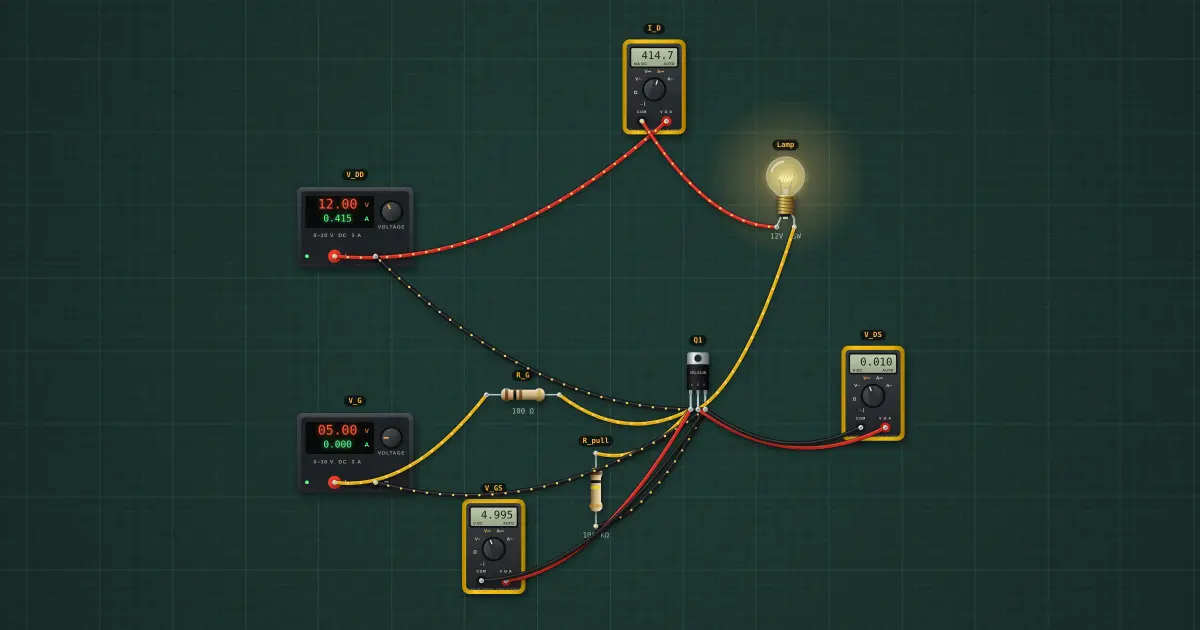
VGS = 4.995 V vs threshold Vth = 1.8 V → overdrive 3.195 V
Fully on (linear region): RDS(on) ≈ 1 / (K·(VGS − Vth)) = 25.1 mΩ, so VDS = 10.4 mV and the MOSFET dissipates only 4.33 mW.
The gate draws no steady current. RG limits the charging spike, and Rpull keeps the gate at 0 V if the drive is disconnected.
Try it on the bench
- Set V_G to 3.3 V (an ESP32 output): still fully on, which is why logic-level MOSFETs matter.
- Set V_G to 2.0 V: the lamp dims and the MOSFET drops several volts, turning watts into heat.
- Set V_G to 1.5 V: below threshold, everything is off.
Parts on the bench
- 2 × Bench power supply
- 2 × Resistor
- N-channel MOSFET
- 3 × Digital multimeter
- Incandescent bulb
In the course
Zen’s Electronics Design Mastery, module “Transistors”.