Transistor as a switch
Give the base far more current than I_C / β needs and the transistor saturates: fully on, with only about 0.1 V across it, so it stays cool. With too little base current it sits half-on and turns the difference into heat.
Open this lesson in the labFree, in your browser, no account needed.
How it works
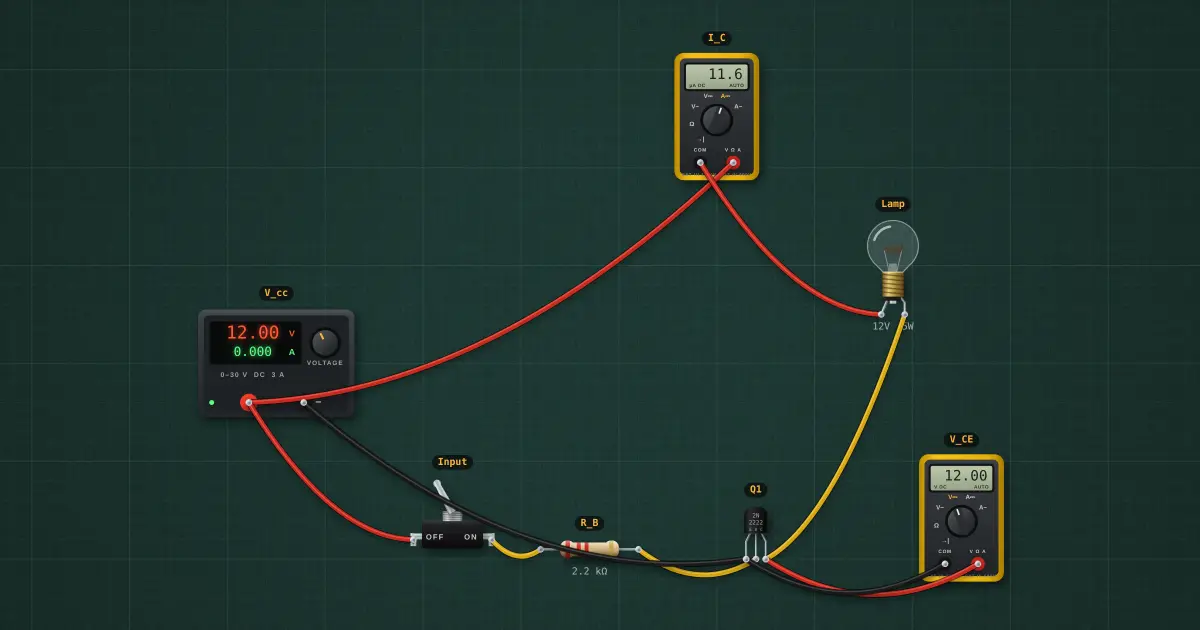
Lamp current when fully on ≈ VCC / Rlamp = 415.7 mA, so the base needs at least IC/β = 2.271 mA.
IB = (Vin − VBE) / RB ≈ (12 − 0.75) / 2.2 kΩ = 0 A, switch is off. Designers aim for 3–10× (a “forced β” of 20–50).
Transistor heat = VCE · IC = 0 W
Try it on the bench
- Flip the Input switch: the lamp lights fully and V_CE drops to about 0.1 V.
- Change R_B to 47 kΩ: now I_B × β is too small, the lamp glows dimly and the transistor drops ~10 V while carrying 40 mA. Watch its heat.
- A real design adds a 10 kΩ resistor from base to emitter so the base cannot float when the input is open.
Parts on the bench
- Bench power supply
- Toggle switch
- Resistor
- NPN transistor
- 2 × Digital multimeter
- Incandescent bulb
In the course
Zen’s Electronics Design Mastery, module “Transistors”.