LDO vs buck: choosing a 3.3 V rail
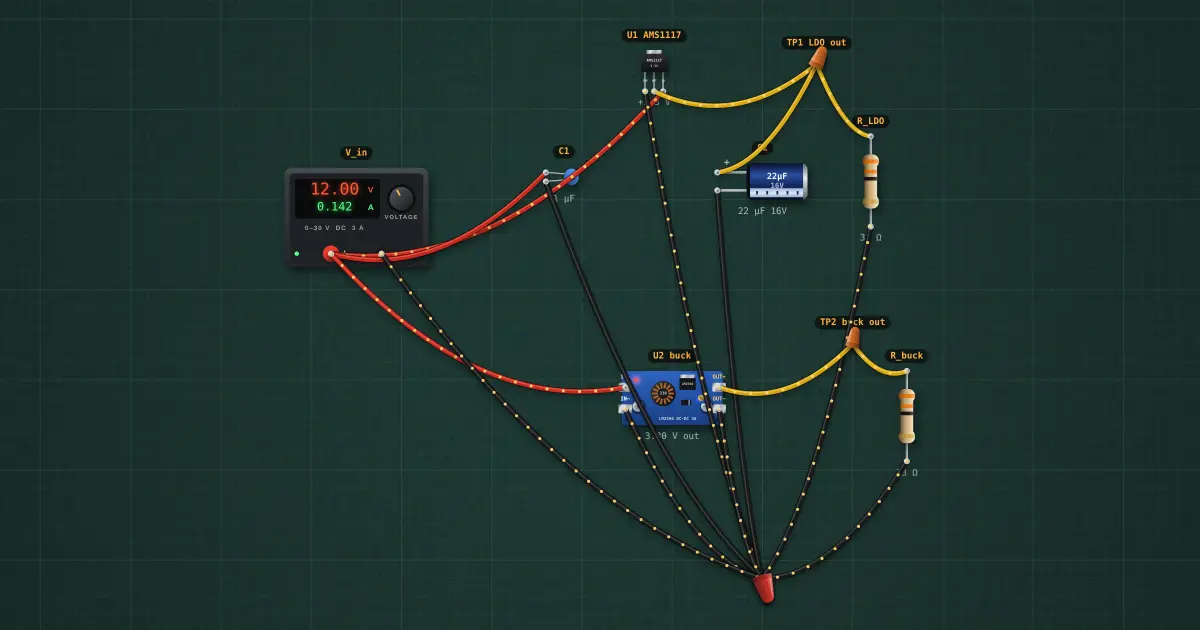
Two ways to make 3.3 V for a 100 mA load from 12 V. The AMS1117 linear regulator burns the difference as heat: its efficiency can never beat V_out ÷ V_in. The buck module switches, and keeps most of the power. The LDO wins on noise, cost and parts count when the voltage gap is small.
Open this lesson in the labFree, in your browser, no account needed.
How it works
LDO: the same current flows in as out (plus about 5 mA for the chip), so efficiency = 3.3 × 100 mA ÷ (12 × 105 mA) = 26 %, and the AMS1117 dissipates 870 mW.
Buck: input current ≈ output power ÷ (efficiency × V_in); expect 75–90 %.
The AMS1117 needs about 1.1 V of headroom: below roughly 4.4 V in, its output sags.
Try it on the bench
- Set V_in to 5 V: the LDO is 64 % efficient, good enough for a small load.
- Set V_in to 4 V: below the LDO’s dropout, its output sinks under 3.3 V.
Parts on the bench
- Bench power supply
- AMS1117 regulator
- Ceramic capacitor
- Electrolytic capacitor
- 2 × Resistor
- Step-down converter
In the course
Electronics Technician, module “Power supplies”.