LED constant-current driver
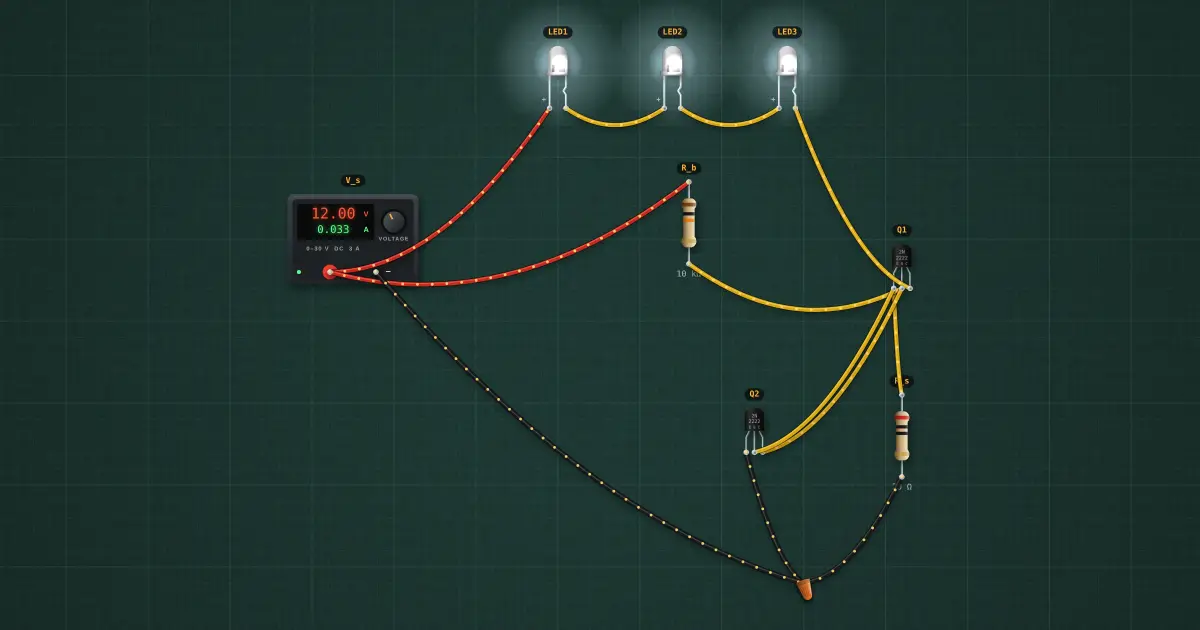
LEDs want a set current, not a set voltage. Two transistors make a current sink: Q1 carries the LED current through R_s; as soon as R_s drops one V_BE, Q2 turns on and steals Q1’s base drive. The current stays at V_BE ÷ R_s whatever the supply does.
Open this lesson in the labFree, in your browser, no account needed.
How it works
Q2 holds the drop across R_s at its own V_BE. With about 1.1 mA through Q2 (from R_b), V_BE ≈ 0.656 V, so
I_LED = V_BE ÷ R_s = 0.656 ÷ 20 = 32.8 mA, independent of the supply as long as there is headroom for three LEDs (≈ 9.3 V) plus about 1.5 V.
Try it on the bench
- Set V_s to 14 V, then 11 V: the current stays put. Below about 10.8 V there is no headroom and it falls.
Parts on the bench
- Bench power supply
- 3 × LED
- 2 × NPN transistor
- 2 × Resistor
In the course
Electronics Technician, module “Transistor circuits”.