Precision rectifier (superdiode)
A diode alone cannot rectify a 0.3 V signal: it needs 0.6 V just to conduct. Put it inside an op-amp’s feedback loop and the op-amp drives its output as far as needed to make the cathode follow the input exactly. The diode drop disappears.
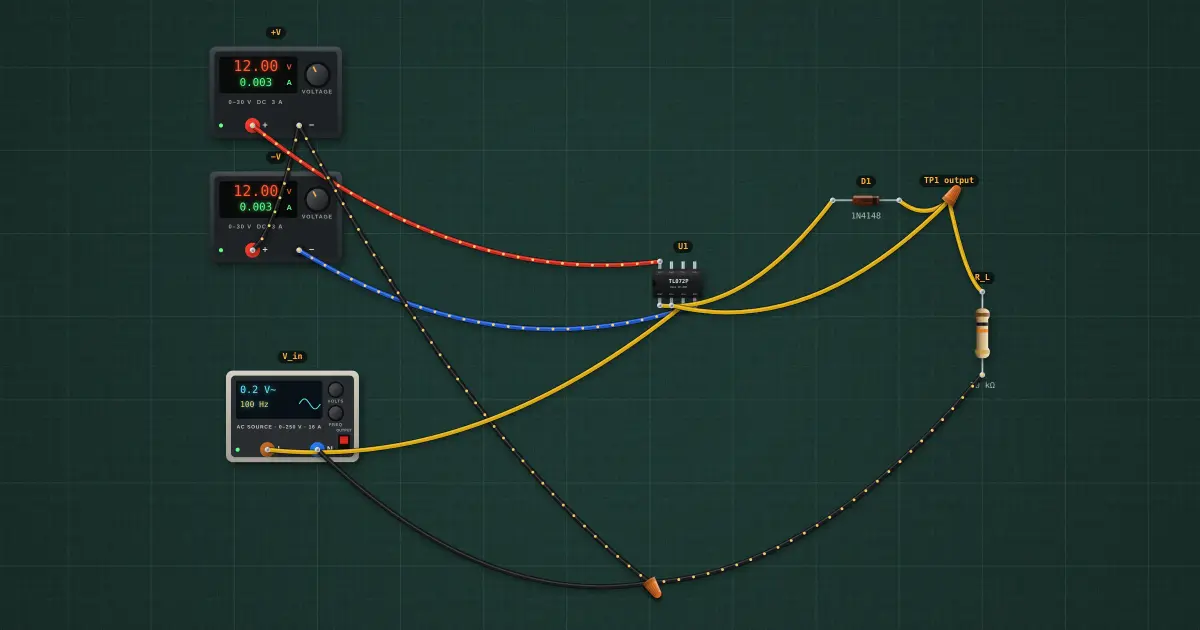
Open this lesson in the labFree, in your browser, no account needed.
How it works
Input peak 283 mV. The output follows positive half-cycles exactly: peak 283 mV, and stays at 0 V on negative half-cycles.
A bare diode would give nothing at all.
Try it on the bench
- Raise the frequency to 10 kHz: the op-amp cannot slew out of negative saturation fast enough and the output gets late.
Parts on the bench
- 2 × Bench power supply
- AC source
- Op-amp
- Signal diode
- Resistor
In the course
Electronics Engineering, module “Op-amps and feedback”.