12. 555 timer: stay on after they pass
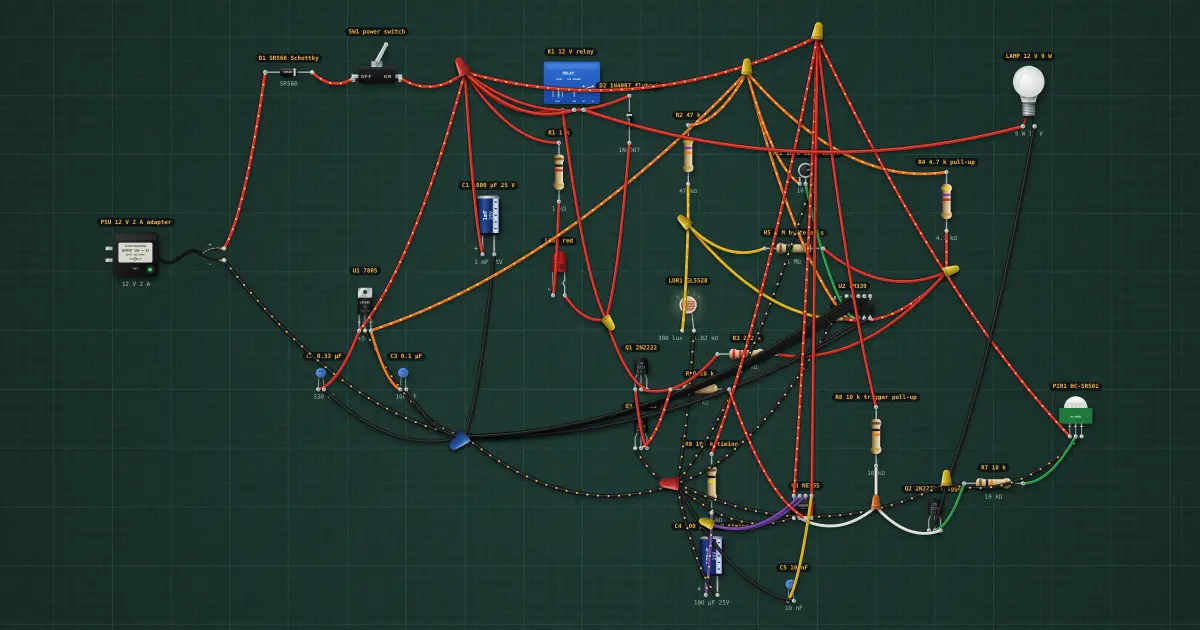
Step 12 of the automatic light: The PIR now drives Q2 as an inverter, pulling TRIG low while it sees movement (R8 keeps TRIG high otherwise). U3’s output drives Q3, which replaces Q2 in the AND below Q1. R9 100 k × C4 100 µF × 1.1 = 11 s: the lamp stays on 11 s after the trigger, much longer than the PIR’s own hold. Component 12 of 14: the 555 timer. The 555 is the classic timer chip. As a monostable, a pulse on TRIG (pulled below ⅓ of the supply) sets its output high, and it stays high until a capacitor charging through a resistor reaches ⅔ of the supply: t = 1.1 × R × C, whatever the trigger does after that.
Build it in the labGuided build, test sheet and fault finding, free in your browser.
Parts list
- DC adapter
- Schottky diode
- Toggle switch
- 2 × Electrolytic capacitor
- 9 × Resistor
- LED
- 7805 regulator
- 3 × Ceramic capacitor
- Photoresistor (LDR)
- 3 × NPN transistor
- LM339 quad comparator
- Potentiometer
- PIR motion sensor
- 555 timer
- Relay
- Rectifier diode
- 12 V DC LED bulb
Test procedure
Each test has an expected value and a pass range, like a factory test sheet:
- Dark and movement: lamp on
- Still on 8 s later (the PIR has long dropped)
- Off again after the timer
How it works
The 555 timer. The 555 is the classic timer chip. As a monostable, a pulse on TRIG (pulled below ⅓ of the supply) sets its output high, and it stays high until a capacitor charging through a resistor reaches ⅔ of the supply: t = 1.1 × R × C, whatever the trigger does after that.
Reading it. DIP-8: 1 GND, 2 TRIG, 3 OUT, 4 RESET (tie high), 5 CTRL (10 nF to ground), 6 THR, 7 DIS, 8 VCC. Runs on 4.5–16 V; the output can drive 200 mA.
Testing it. Powered, short TRIG to ground for a moment: OUT goes high (near the supply) and comes back low after 1.1·R·C. If it never goes low, check the timing capacitor; if it never goes high, check RESET.
In the build. The PIR now drives Q2 as an inverter, pulling TRIG low while it sees movement (R8 keeps TRIG high otherwise). U3’s output drives Q3, which replaces Q2 in the AND below Q1. R9 100 k × C4 100 µF × 1.1 = 11 s: the lamp stays on 11 s after the trigger, much longer than the PIR’s own hold.
Builds on lesson 11: everything from before is still there.
Next: lesson 13, buzzer.
Things to try
- Click the PIR at night and time how long the lamp stays on.
- Change C4 to 47 µF: about 5 s.
Background
One circuit, built up one part at a time: by lesson 14 it is a solar-powered, dusk-sensing, motion-triggered timed lamp with an alarm.