Crystal radio
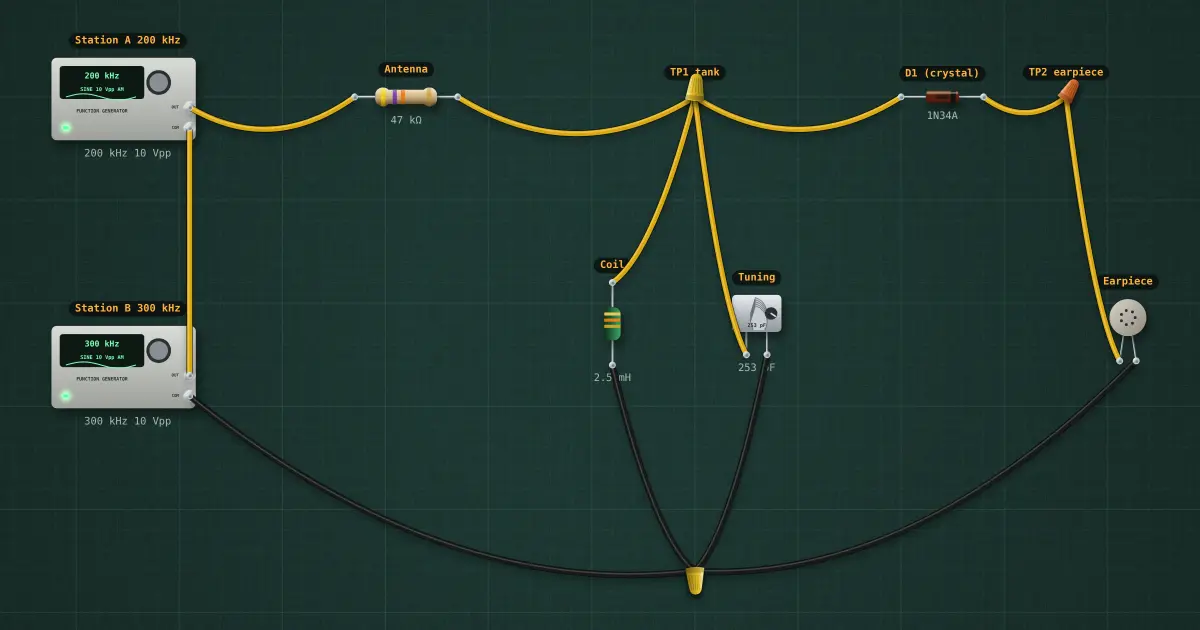
Two AM stations reach the antenna together. The coil and tuning capacitor resonate at one frequency, building up that station and shunting the others away; the germanium diode detects its envelope, and the earpiece turns that straight into sound. No battery: the radio runs on the energy of the radio wave.
Open this lesson in the labFree, in your browser, no account needed.
How it works
Tank resonance f₀ = 1 ÷ (2π√(L·C)) = 200 kHz (C = 253 pF).
Station A (200 kHz) needs C = 253 pF; station B (300 kHz) needs 113 pF.
Try it on the bench
- Set Tuning to about 0.29 of its range: you now hear station B’s 400 Hz tone.
- Change the antenna resistor to 10 kΩ: louder, but both stations bleed through (less selective).
Parts on the bench
In the course
Electronics Engineering, module “Filters and frequency response”.