Economics: payback, and what a battery really costs per kWh
A solar system is bought once and paid back by the kWh it replaces: payback = cost ÷ (kWh replaced × tariff). Panels last 25 years losing about 0.5 % a year; batteries are bought by the cycle. That is where lead-acid and lithium part ways: a lead-acid bank costs a third up front and three to five times as much per kWh stored over its life, because it gives half its nameplate for 450 cycles against 85 % for 3000.
Open this lesson in the labFree, in your browser, no account needed.
How it works
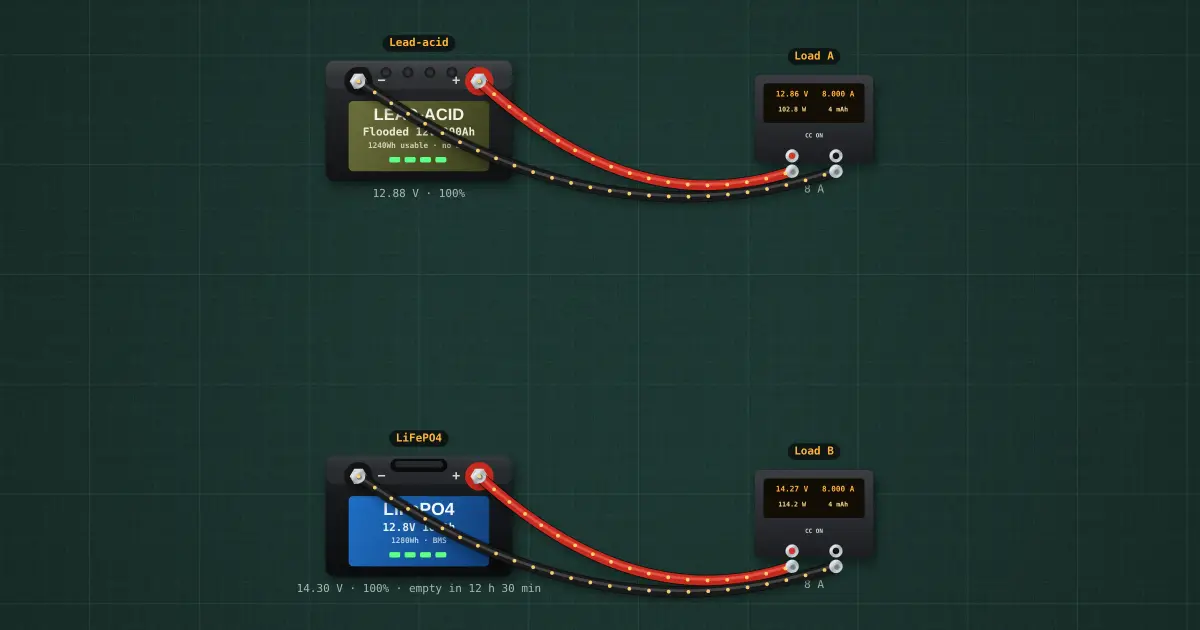
Two banks with about the same usable energy: a 200 Ah lead-acid (2480 Wh nameplate, 1240 Wh usable, about ₱16,120) and a 100 Ah LiFePO4 (1280 Wh, 1088 Wh usable, about ₱23,040).
Over their lives: lead-acid 450 cycles × 1240 Wh = 558 kWh stored for ₱28.9 per kWh; LiFePO4 3000 × 1088 Wh = 3264 kWh for ₱7.1 per kWh. Prices are the studio’s (editable there).
Where lead-acid still wins: standby duty (a UPS that cycles twice a year), a budget that cannot stretch, places with no lithium supply. Where it loses: anything cycled every night.
Try it on the bench
- Let it run: the lead-acid hits 50 % (its working floor) at about the same moment the LiFePO4 is at 80 %.
- Open the Solar studio, step 5: change the tariff and the prices and watch the payback.
- Change the studio’s chemistry to lead-acid: the bank doubles and the lifetime cost per kWh is shown beside lithium.
Parts on the bench
In the course
Solar PV Systems, module “13 · Economics”.
More on solar pv physics
- The IV curve: Voc, Isc and the knee
- Cold mornings raise Voc; hot noons cut power
- Shading and bypass diodes: a shadow costs more than its size
- A string against the controller: the cold-morning Voc
- PWM against MPPT: the harvest, as a number
- Lead-acid against LiFePO4: usable capacity, voltage and life
- Wiring, fuses and breakers for an array: the 1.25 and 1.56 rules
- Grounding, bonding and surge protection: the two jobs of earth