Light-activated switch with relay
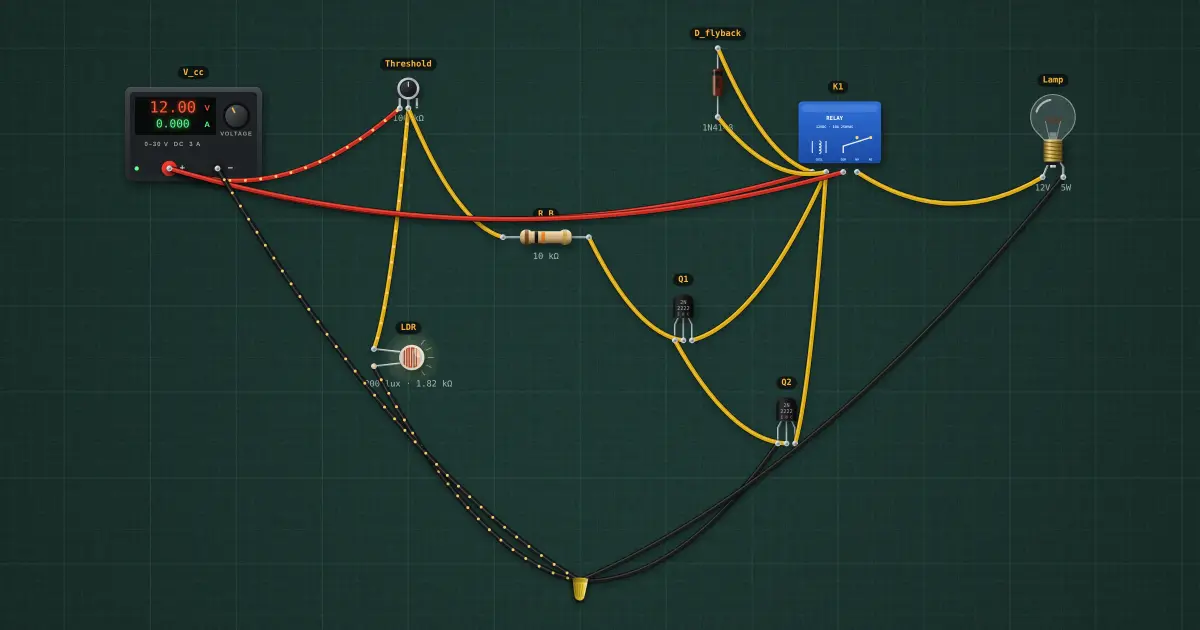
An LDR and a pot form a divider whose middle rises as it gets dark. A Darlington pair turns that into enough current to pull in a relay, which switches the lamp. The pot sets the light level where it switches.
Open this lesson in the labFree, in your browser, no account needed.
How it works
The relay coil draws (12 − V_CE(sat)) ÷ R_coil ≈ (12 − 0.8) ÷ 400 = 28 mA when on. A Darlington needs only about 30 µA of base current for that, so the divider is hardly loaded.
The diode across the coil catches the inductive kick when the relay releases.
Try it on the bench
- Set the LDR to 5 lux (dusk): the relay pulls in and the lamp lights.
- Turn the threshold pot: it switches at a different light level.
Parts on the bench
- Bench power supply
- Potentiometer
- Photoresistor (LDR)
- Resistor
- 2 × NPN transistor
- Relay
- Signal diode
- Incandescent bulb
In the course
Electronics Technician, module “Transistor circuits”.