Long-tailed pair (differential amplifier)
Two matched transistors share one tail current. A difference between the bases steers the current from one side to the other, while a change common to both bases just moves both emitters together. This is the input stage of every op-amp.
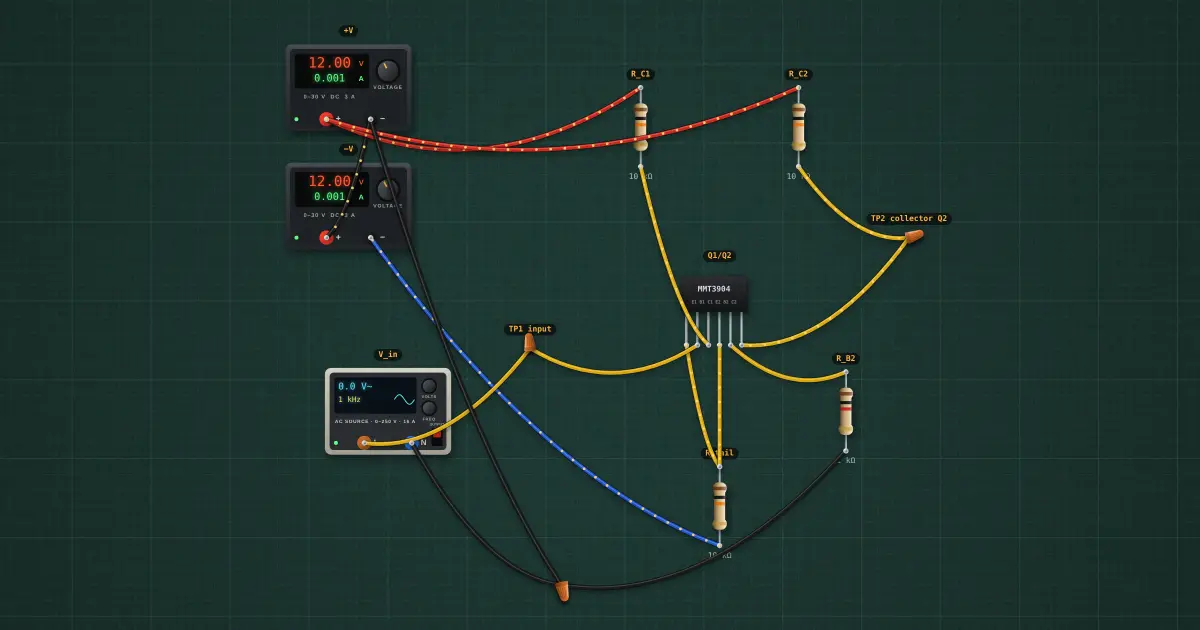
Open this lesson in the labFree, in your browser, no account needed.
How it works
Tail current ≈ (12 − 0.65) ÷ R_tail = 1.14 mA, so each side carries I_C = 568 µA and r_e = V_T ÷ I_C = 45.6 Ω.
Single-ended differential gain A = R_C ÷ (2 r_e + R_B2 ÷ β) = 105 (β ≈ 220; with R_B2 = 0 it is simply g_m · R_C ÷ 2).
Common-mode gain ≈ R_C ÷ (2 R_tail) = 0.50.
Try it on the bench
- Raise V_in to 100 mV peak: the output clips, because the whole tail current steers to one side once the inputs differ by about 4·V_T.
- Set the transistor mismatch to 5 mV: the output collector’s DC level shifts.
Parts on the bench
- 2 × Bench power supply
- Matched transistor pair
- 4 × Resistor
- AC source
In the course
Electronics Engineering, module “Transistor amplifiers”.