Safety on PV jobs
Work on a stand-alone PV system without getting shocked, burned or hurt from a fall. You will know why DC from modules and batteries behaves differently from the AC in a house, and the order of steps that keeps you safe.
Open this lesson in the labFree, in your browser, no account needed.
How it works
DC is different
In a house you open the main breaker and the wiring is dead. A PV array does not work that way. Every module makes voltage as soon as light reaches it, even on a cloudy day and even at low morning light. The open-circuit voltage hardly drops in weak light; only the current falls. A string that you have just unplugged from the controller is still live on its own cable ends.
DC arcs are also harder to stop. AC passes through zero volts 120 times a second on a 60 Hz supply (100 on 50 Hz), and an arc tends to go out at each zero. DC never passes through zero, so an arc drawn by pulling a connector apart under current can keep burning, melt the connector and start a fire. That is why the rules below are strict.
- Never disconnect under load. PV connectors and most plain terminals are not switches. Stop the current first with a breaker or disconnect rated for DC, then unplug.
- Open the DC breaker first. Before you touch the controller wiring, open the PV breaker (array side) and the battery breaker or fuse holder, in the order the controller's manual gives.
- Take the light away. If you must work on module wiring, cover the modules with an opaque sheet or work at dawn or dusk. Covering reduces the current, not always the voltage to zero, so still test.
- Test before touch. Use a meter rated for the DC voltage of the array, check it on a known live source before and after, and measure every conductor you will touch.
Battery hazards
A 12 V battery will not usually shock you through dry skin. The danger is current. A battery can push hundreds or thousands of amperes into a short circuit, enough to weld a spanner across the terminals, melt a ring or watch strap into your finger and spray molten metal.
- Remove rings, watches, bracelets and necklaces before battery work.
- Use insulated tools, or wrap the handle of a spanner with tape so only the jaw is bare. Never lay a tool on top of a battery.
- Fit the battery fuse or breaker as close to the battery as practical, and connect it last.
- Keep terminal covers on. Make one connection at a time and keep the other cable end covered.
Lead-acid batteries give off hydrogen while charging, mostly near the end of charge. Hydrogen is explosive in air, so the battery area needs ventilation and no sparks, flames or smoking. The electrolyte is sulfuric acid: wear goggles and gloves when checking cells, and have clean water nearby to flush skin or eyes. Lithium batteries (including LiFePO4) do not vent hydrogen in normal use, but a damaged, crushed, overcharged or shorted cell can go into thermal runaway: it heats itself, vents gas and may catch fire. LiFePO4 is one of the more stable lithium chemistries, but not immune. Never use a lithium battery without its battery management system (BMS), never charge it outside its temperature range, and set aside any cell that is swollen, dented or hot.
Roof and ladder work
Falls hurt more PV installers than electricity does. Plan the roof work before you climb.
- Use a ladder in good condition, on firm ground, at about 1 in 4 (one unit out for every four units up), tied off at the top and extending about 1 m above the edge.
- Use fall protection where the job and local rules require it: a harness with a proper anchor, guardrails or a scaffold.
- Fragile roofs (old fibre-cement sheets, rusted or thin metal, skylights) can break under a person. Walk only on the purlin or rafter lines, or use crawl boards.
- Do not go up in rain, strong wind or lightning. A wet metal roof is slippery, and a module catches the wind like a sail.
- Lift modules with two people, or with a rope and a helper. Carry them by the frame, not by the junction box or cables.
Heat and sun
A metal roof at noon in the tropics can burn bare skin, and so can module frames and glass. Start early, take breaks in shade, drink water often and watch each other for signs of heat exhaustion: heavy sweating, dizziness, headache, nausea, confusion. Confusion or hot dry skin points to heat stroke, which is an emergency.
PPE
| Item | Why |
|---|---|
| Insulated gloves rated for the voltage | Live DC work and testing |
| Safety glasses or goggles | Arc flash, drilling, battery acid |
| Hard hat | Falling tools and parts under a roof job |
| Safety shoes with good grip | Roof work, dropped modules |
| Long sleeves, hat, sunscreen | Sunburn and hot surfaces |
| Harness and lanyard | Work at height |
Lockout/tagout on a PV system
Lockout/tagout means you isolate the energy, lock the isolator so no one can turn it back on, tag it with your name and the reason, and test to prove it is dead. On a PV system there are at least two sources to isolate: the array and the battery, plus the inverter output if it feeds a distribution board.
- Switch off the loads and the inverter.
- Open the battery and PV breakers in the order the controller's manual gives (often PV first, then battery).
- Lock and tag each one.
- Test at the point of work. Remember that the array side of the PV breaker is still live in daylight.
- Cover the modules if you will work on the array wiring itself.
First response
If someone is in contact with a live conductor, do not touch them. Open the breaker or pull them free with something dry and non-conductive. Call for help (911 in the Philippines, or the local emergency number). Check breathing, and start CPR if you are trained and it is needed. Treat burns with cool running water. For acid in the eyes, flush with clean water for at least 15 minutes and get medical help. Know where the first-aid kit and the fire extinguisher are before work starts; for an electrical fire use an extinguisher rated for electrical fires, not water.
The grounding and surge protection lesson covers how the system protects people once it is finished. This lesson is about keeping you safe while you build it.
On the job
- Rings and watches off; insulated tools out.
- Meter checked on a known source; every conductor tested before touch.
- DC breakers opened before any connector is unplugged; nothing unplugged under load.
- Modules covered, or work done at low light, when touching array wiring.
- Ladder tied off, fall protection in place, weather checked.
- Water, shade and a buddy; first-aid kit and extinguisher on site.
Try it on the bench
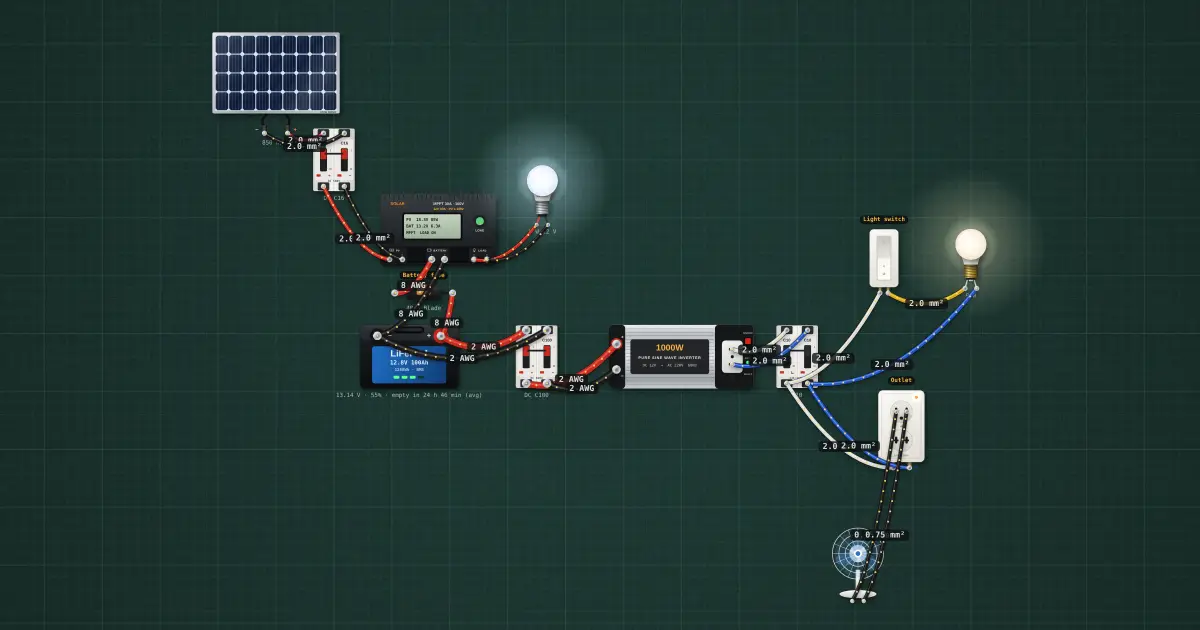
- Open the DC breaker between the panel and the controller, then measure the panel’s own terminals with the multimeter: the voltage is still there, because the panel is live whenever there is light.
- Set the panel’s sunlight to 0 W/m² and measure again: covering the panel is how you take the source away.
- Open the battery fuse and check the controller and inverter: the battery side is now isolated, but the battery terminals themselves are still live.
Parts on the bench
- Solar panel
- 2 × DC breaker
- Solar charge controller
- LiFePO4 battery
- Power inverter
- AC breaker
- 12 V DC LED bulb
- 220 V bulb
- 220 V desk fan
- Wall switch
- Wall outlet
- Fuse
In the course
PV Systems Installation (NC II-aligned), module “1 · Safety on PV jobs”.