SEPIC: output above and below the input
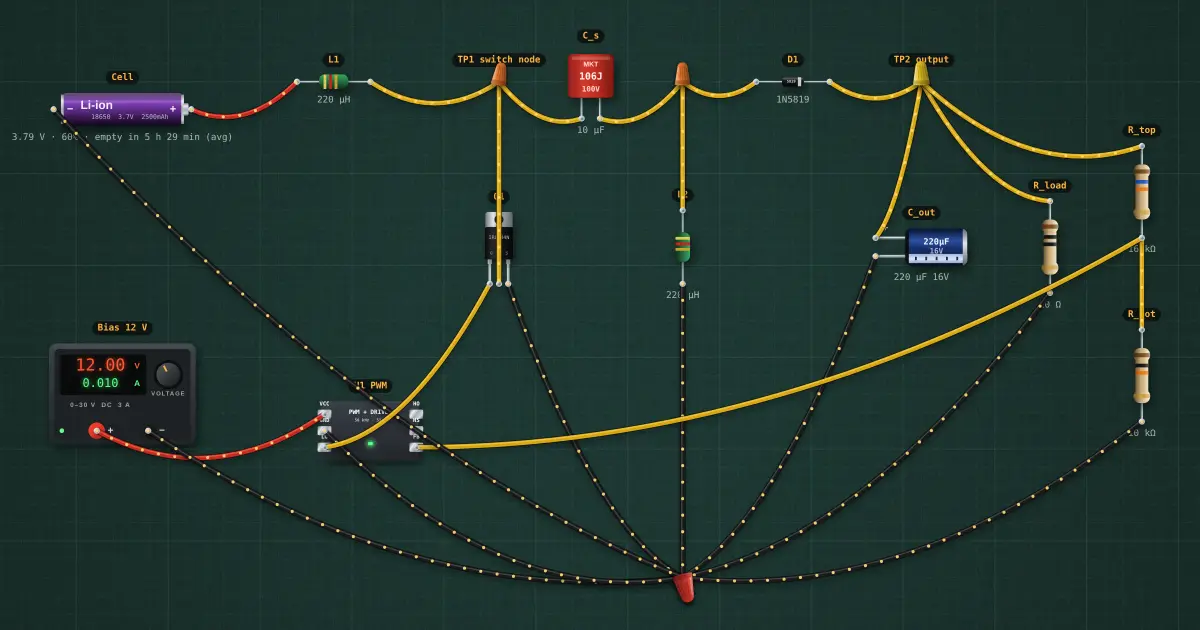
A Li-ion cell runs from 4.2 V full to 3.0 V empty, but the circuit wants 3.3 V the whole time. A SEPIC converter can step up or down: two inductors and a coupling capacitor, with the duty cycle setting V_out = V_in × D ÷ (1 − D). Here the controller closes the loop and holds 3.3 V as the cell drains.
Open this lesson in the labFree, in your browser, no account needed.
How it works
The loop holds FB at 1.25 V: V_out = 1.25 × (1 + 16k/10k) = 3.25 V.
A SEPIC needs D ÷ (1 − D) = (V_out + V_F) ÷ V_in, so D = 100 % at 0.00 V in (50 % is the point where output equals input).
Try it on the bench
- Set the cell to full (variant) and to nearly empty: the output does not move; the duty does.
Parts on the bench
- 18650 Li-ion cell
- Bench power supply
- PWM controller + gate driver
- 2 × Axial choke
- N-channel MOSFET
- Film capacitor
- Schottky diode
- Electrolytic capacitor
- 3 × Resistor
In the course
Electronics Engineering, module “Diodes and supplies”.