Conduit, raceways and boxes: roughing-in
You will be able to choose the right conduit for a location, cut, ream and bend it, keep bends within the 360° limit, support it, choose boxes and check conduit fill. A neat rough-in makes the wire pull easy and the installation safe for decades.
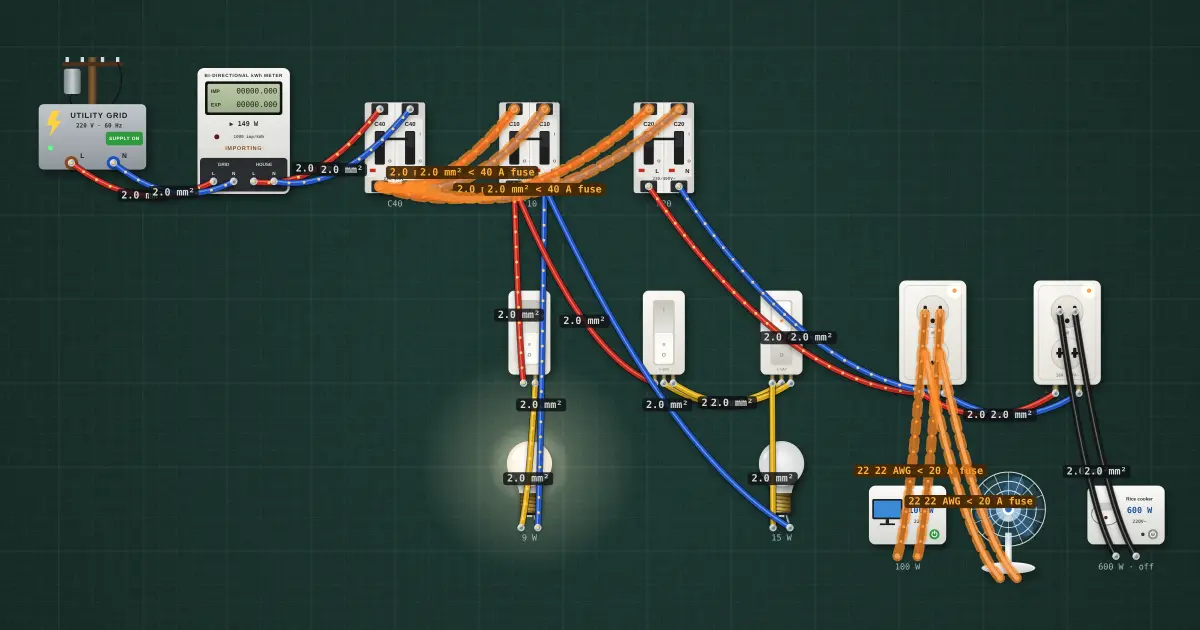
Open this lesson in the labFree, in your browser, no account needed.
How it works
Types of conduit
| Type | What it is | Typical use |
|---|---|---|
| PVC (rigid non-metallic) | Plastic pipe, joined with solvent cement | Concealed in concrete slabs, walls and underground; corrosive or damp places. The common choice in Philippine houses. |
| EMT (electrical metallic tubing) | Thin-wall steel tube, unthreaded, joined with set-screw or compression fittings | Exposed runs indoors in commercial buildings; ceilings and walls where it won't be physically damaged. |
| IMC (intermediate metal conduit) | Threaded steel, thinner than RMC | Exposed outdoor and industrial runs that need protection. |
| RMC (rigid metal conduit) | Heavy-wall threaded steel (or aluminium) | Places with high risk of physical damage, service entrances, some hazardous areas. |
| Flexible metal conduit and liquid-tight flexible conduit | Spiral metal or plastic, bends by hand | Short final connections to motors, aircon units and equipment that vibrates or must move. Liquid-tight where wet. |
Each type has its own article in the code (the conduit articles in Chapter 3 of the PEC and the NEC) that says where it may and may not be used. Your plans and notes say which type goes where.
Cutting and reaming
- Cut square with a hacksaw (a mitre box helps) or a pipe cutter.
- Ream every cut end inside with a reamer or file. A sharp burr will strip insulation off the wires as you pull them.
- For PVC, clean the ends, apply solvent cement to both the pipe and the fitting, push in fully with a quarter turn, hold a few seconds.
- For EMT, push the tube fully into the fitting and tighten the set screw or compression nut firmly.
Bending
| Bend | What it does |
|---|---|
| 90° (stub-up) | Turns the run around a corner or up out of a slab or floor. |
| Offset | Two equal bends in opposite directions to move the run sideways or out, for example to step out from a wall to a box. |
| Saddle (three-point or four-point) | Takes the run over an obstacle such as a pipe or beam and back to the same line. |
| Back-to-back 90° | Two 90° bends in the same plane, for example down one wall, across and up another. |
EMT and IMC are bent with a hand bender sized for the conduit; the marks on the bender (arrow, star, rim notch) and the bender's own multiplier table tell you where to place the bend. PVC is bent with a heat blanket or hot box, or you use factory elbows. Don't heat PVC with an open flame, and don't let a bend kink or flatten: the inside diameter must stay round.
The 360° rule
Between two pull points (boxes, conduit bodies or fittings where you can reach the wire), the bends in a run must not add up to more than 360° in total. Four 90° bends is the limit. Offsets and saddles count too: a 30° offset is two 30° bends, 60° total. The rule exists because every bend multiplies the pulling force; past 360° the wire can be damaged by pulling or can't be pulled at all. If you need more, add a pull box.
Supports and securing
Conduit must be fastened securely with straps or hangers, within a set distance of every box and fitting and at regular spacing along the run. The distances depend on the conduit type and size: follow the code table for the conduit type and size, and the plan notes. Don't support conduit from ceiling hanger wires or other trades' pipes. Where PVC is exposed to temperature changes over long runs, use expansion fittings as the code requires.
Boxes
| Box | Use |
|---|---|
| Utility box (rectangular, single gang) | A switch or convenience outlet in a wall |
| Octagonal box | Ceiling lighting outlets; junctions in ceilings |
| Square box (with a mud ring) | Two devices, or more wires than a utility box holds |
| Junction box | Where circuits split or join, with a blank cover |
| Pull box | A larger box in long or bendy runs, only for pulling; sized by the code for the conduit sizes entering it |
Set boxes flush with the finished wall surface (or within the small setback the code allows), plumb and level. Boxes that hold a fixture must be rated to support it. Keep every box accessible after the building is finished.
Conduit fill
Wires need room to be pulled and to shed heat. For three or more conductors, they may fill at most 40 % of the conduit's inside area (the limits are 53 % for one conductor and 31 % for two). To check: add the cross-section areas of all the insulated wires (from the code's wire dimension table, which includes the insulation, not just the copper), and compare with 40 % of the conduit's internal area from the conduit table. Tables in the code annex list the maximum number of wires of one size for each conduit size directly.
Wireways and cable trays
A wireway is a sheet-metal trough with a hinged or screw cover, used where many circuits run together, such as near panels. A cable tray is an open ladder or channel that supports cables in commercial and industrial buildings. Both have their own code rules for fill and for which cables may be used.
Bonding of metal raceways
Metal conduit and boxes must be electrically continuous, so that a fault to the metal returns to the source and trips the breaker. Every fitting must be tight; paint is removed under locknuts where needed; bonding bushings or jumpers are used where the code calls for them, such as at service entrances and some concentric knockouts. Many installers also pull a green equipment grounding conductor in metal conduit, and the plans usually require one in PVC.
Layout from the plan
- Mark box positions on walls and ceilings from the layout, at the mounting heights in the notes.
- Plan routes: short, with few bends, away from water pipes and heat.
- Count bends between pull points; add boxes where the total would pass 360°.
- Size each conduit for the number of wires shown on the plan.
- Before concrete is poured, cap open ends and check every run is continuous.
On the job
- Right conduit for the location, as the plans say.
- Cut square, ream every end.
- No more than 360° of bends between pull points.
- Supports per the code table; boxes flush, level and accessible.
- Fill within 40 % for three or more wires; metal raceways bonded.
Try it on the bench
- Trace each wire on the house bench from its breaker to its load, as if you were laying out conduit runs. Where would you put the junction boxes?
- Count the conductors that would run to each wall switch and each outlet. Which run would need the larger conduit?
- Run the 🛡 Safety check and note any wiring problems it finds before roughing-in would be signed off.
Parts on the bench
- Utility grid
- Net meter
- 3 × AC breaker
- 3 × Wall switch
- 2 × 220 V bulb
- 2 × Wall outlet
- 2 × Household appliance
- 220 V desk fan
In the course
Electrical Installation and Maintenance (NC II-aligned), module “6 · Roughing-in: conduit, raceways and cables”.