Panelboards and protective devices
You will be able to name the parts of a service from the meter to the branch breakers, explain how a breaker trips, read its ratings, and say what an RCD and an SPD protect against and what they don't. Protective devices are what turn a fault into a tripped breaker instead of a fire.
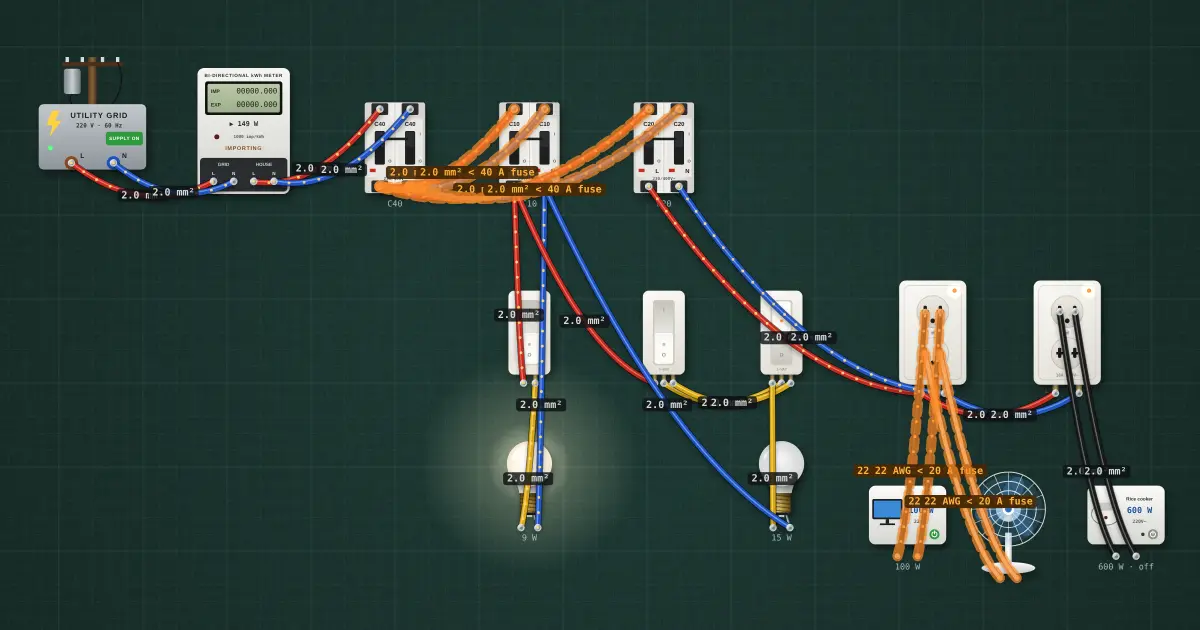
Open this lesson in the labFree, in your browser, no account needed.
How it works
From the utility to the branch circuits
- Service drop or lateral: the utility's conductors, overhead or underground, to the building.
- Service entrance: the conductors and fittings from the point of connection to the service equipment (for example a weatherhead and service entrance conduit).
- Meter: the utility's kWh meter, usually in a meter base outside.
- Main breaker (service disconnect): one device that can cut off the whole building. It protects the feeder and the panel.
- Panelboard: the enclosure with bus bars, the main and the branch breakers, plus a grounding bar (and a neutral bar where the system has a neutral).
- Branch circuit breakers: one per circuit, sized to protect that circuit's wire.
Rules for services, feeders and panelboards are in the PEC Chapter 2 and 4 articles (the same structure as the NEC). Utilities also have their own requirements for the meter location and service entrance, so check with the local utility.
How a thermal-magnetic breaker trips
| Fault | What happens | Which part acts |
|---|---|---|
| Overload: too many loads, a bit more current than rated, for a long time | Wire heats slowly; insulation would degrade over time | Thermal element: a bimetal strip heats, bends and trips the breaker. The more the overload, the faster it trips (seconds to many minutes). |
| Short circuit or ground fault: a direct path, very large current | Huge current, violent heating and arcing | Magnetic element: a coil pulls a trip bar almost instantly. |
This is why a breaker doesn't trip when a motor starts (a brief surge) but does trip on a sustained overload. A breaker that trips repeatedly is telling you something: find the cause before you reset it again. Never replace it with a larger one to stop the trips; the breaker protects the wire.
Breaker ratings
- Current rating (A): the current it carries without tripping, marked on the handle (15, 20, 30 A ...).
- Voltage rating: must be at least the circuit voltage. A breaker for 230 V line-to-line needs that rating, normally a two-pole breaker on a two-hot service.
- Number of poles: 1P switches one conductor; 2P switches both and opens them together. On a Philippine line-to-line service a single-pole breaker leaves the other hot wire live.
- Interrupting capacity (kA, AIC): the largest fault current it can safely break. It must be at least the available fault current at that point, which is higher close to a large utility transformer. A breaker with too low a rating can explode during a short circuit.
- Listing and compatibility: use breakers made and listed for that panelboard.
Safety switches and fuses
A safety switch (disconnect) is a lockable enclosed switch that isolates equipment such as an aircon outdoor unit or a pump, often within sight of it so a technician can lock it off. Some are fused. A fuse is a wire or strip that melts on overcurrent. It is simple and fast but has to be replaced after it operates, and must be replaced with the same type and rating. Never bridge a fuse with wire or foil.
RCD / GFCI
A residual-current device (RCD), called a GFCI in the US, compares the current going out with the current coming back. If they differ by more than its trip setting, current is leaking somewhere else, perhaps through a person to ground, and it trips within a fraction of a second. For protection of people the trip setting is 30 mA (US GFCIs trip at about 5 mA).
| An RCD protects against | An RCD does not protect against |
|---|---|
| Shock from line to ground, such as touching a live part while standing on a wet floor | Shock between two conductors of the same circuit (hand on line, other hand on the other line or neutral): the current goes out and comes back the same way |
| Leakage from damaged insulation or wet appliances, a fire risk | Overloads and short circuits, unless it is a combined breaker and RCD (RCBO) |
Press the test button regularly, as the device label says. It creates a small deliberate leak; if the RCD doesn't trip, replace it. Bathrooms, outdoor outlets, kitchen counters and similar wet locations are typical places where the code or the plans require them.
Surge protective devices (SPD)
An SPD limits brief voltage spikes from lightning or utility switching by diverting the surge to ground. It is installed at the panel (and sometimes at sensitive equipment), connected with short, straight leads to the bus and the grounding bar. An SPD needs a good ground to work and does not replace a breaker or an RCD. Many have an indicator that shows when they need replacing after absorbing surges.
Labelling the panel
Every circuit breaker must be clearly labelled with what it feeds: "Ckt 3: Aircon, bedroom 1", not "Spare" or "Lights". Fill in the circuit directory on the panel door to match the schedule of loads and the as-builts. Label the main disconnect. Mark the panel with its name and the source it is fed from.
Working clearances
The code requires clear working space in front of panelboards, so a person can work and step back safely. For low-voltage panels the space is commonly about 0.9 m (3 ft) deep, at least as wide as the equipment and not less than the minimum width set by the code, with enough headroom; PEC Article 1.10 and NEC 110 give the exact figures. Keep it free of storage, and keep the panel door able to open fully. Don't install panels in bathrooms or over steps.
On the job
- Trace the service: meter, main, panel, branch breakers.
- Two-pole breakers on two-hot circuits.
- Interrupting rating at least the available fault current.
- RCDs where required; press the test button.
- Every breaker labelled; clear space in front of the panel.
Try it on the bench
- Put the appliances and the fan on one outlet circuit, add up their currents and compare with the breaker rating. In a ⏱ Test run, see whether the breaker holds or trips.
- Add the 30 mA RCD in front of an outlet circuit, then run the 🛡 Safety check and a ⏱ Test run.
- Add an SPD at the panel side of the house bench and run the 🛡 Safety check.
Parts on the bench
- Utility grid
- Net meter
- 3 × AC breaker
- 3 × Wall switch
- 2 × 220 V bulb
- 2 × Wall outlet
- 2 × Household appliance
- 220 V desk fan
In the course
Electrical Installation and Maintenance (NC II-aligned), module “7 · Protective devices, grounding and lightning protection”.