Wires and cables: types, sizes and pulling
You will be able to read the markings on building wire, convert between mm² and AWG sizes, understand what sets a wire's ampacity, follow the colour rules, and pull wire through conduit without damaging it. The wire is the part of the job you can never see again once the walls close.
Open this lesson in the labFree, in your browser, no account needed.
How it works
Reading the wire markings
Building wire is printed along its length with its type, size, voltage rating and temperature rating. The letters describe the insulation:
| Letters | Meaning |
|---|---|
| T | Thermoplastic insulation (PVC) |
| H / HH | Heat resistant: HH is rated 90 °C in dry locations |
| W | Suitable for wet locations |
| N | Nylon outer jacket, which slides through conduit and resists abrasion and oil |
So THHN is PVC insulation with a nylon jacket, 90 °C in dry locations, and THWN is the same construction rated for wet locations. Many wires carry both markings (THHN/THWN) and can be used in either. Building wire for 230 V circuits is typically rated 600 V. Check the printed rating rather than assuming.
Solid against stranded
- Solid wire is one copper conductor. It holds a shape, makes neat terminal loops and is cheaper. It is stiff to pull in larger sizes.
- Stranded wire is many fine strands. It is flexible and pulls more easily through long runs with bends. It needs ferrules or terminals rated for stranded wire where it lands on screw clamps.
- Small sizes such as 2.0 and 3.5 mm² are available both ways; larger sizes are normally stranded. The plans or job spec may say which to use.
Sizes: mm² and AWG
The Philippines sizes wire by cross-sectional area in square millimetres (mm²). The US uses American Wire Gauge (AWG), where a bigger number means a smaller wire, and kcmil above 4/0 AWG. The two series are not identical; the table pairs each common Philippine size with the nearest AWG size and the AWG size's actual area.
| Philippine size (mm²) | Nearest AWG | AWG area (approx. mm²) |
|---|---|---|
| 2.0 | 14 | 2.08 |
| 3.5 | 12 | 3.31 |
| 5.5 | 10 | 5.26 |
| 8.0 | 8 | 8.37 |
| 14 | 6 | 13.3 |
| 22 | 4 | 21.2 |
The pairs are approximate. When a calculation needs the exact area, use the area of the wire you actually have. Countries following IEC practice use yet another series (1.5, 2.5, 4, 6, 10, 16 mm²).
Ampacity: what a wire may carry
Ampacity is the current a conductor can carry continuously without its insulation getting hotter than its rating. It is not a fixed property of the copper. It depends on:
- The insulation temperature rating (60, 75 or 90 °C). Higher-rated insulation tolerates more heat.
- The terminal rating of the breaker or device it lands on. If the terminals are rated 75 °C, you may not use the 90 °C column for the final ampacity, even with THHN wire.
- Ambient temperature: hot ceilings and rooftops lower the ampacity (correction factors).
- How many current-carrying conductors share a conduit: more than three bunched together shed heat poorly (adjustment factors).
- The installation: in conduit, in free air, buried.
The ampacity tables and factors are in PEC Article 3.10 (NEC 310). Use them; don't use a number from memory or a chart of unknown origin. In common Philippine house wiring, lighting circuits use 2.0 mm² on a 15 A breaker and convenience outlets 3.5 mm² on a 20 A breaker, but the plan and the table decide each circuit.
Conductor colours
The code rule is about two conductors:
- The grounded conductor (neutral, where the system has one) is white or grey.
- The equipment grounding conductor is green, green with yellow stripes, or bare.
Those colours may not be used for any other conductor. Ungrounded ("hot") conductors can be any other colour; black, red and blue are common. In practice colours vary, especially in older Philippine installations, and on a line-to-line service there may be no grounded neutral at all, only two hots. Never trust the colour: test. Countries using IEC colours have brown, black and grey for line, blue for neutral and green-yellow for protective earth.
Pulling wire
- Check the conduit: complete, reamed, bends within 360° between pull points, ends capped until now.
- Feed the fish tape from one box to the next. In longer runs, push from the end nearer the bends.
- Attach the wires: strip the ends, bend them through the fish tape's eye and twist back, then tape the head into a smooth, tapered bundle so it doesn't snag at couplings.
- Lubricate long or bendy pulls with wire-pulling lubricant made for the purpose (not oil, grease or soap, which can harm insulation).
- Pull steadily, with a helper feeding the wires in straight and untangled at the other end, so they don't cross and twist.
- Don't over-pull. If it sticks, find out why. Forcing it stretches copper and tears insulation.
- Bending radius: don't kink wire or bend it sharply around box edges. Larger conductors and cables have a minimum bending radius given by the code or maker.
- Leave enough wire in every box to make up connections and to pull a device out for service. A common practice is around 150 mm of free conductor from the point where it leaves the conduit, with enough to reach outside the box opening; the code sets the minimum.
- Label home runs at the panel with the circuit number (tape and marker, or printed labels), and label wires in boxes where several circuits meet.
- No splices in conduit. Wires run unbroken from box to box. Splices belong only in boxes.
- All conductors of a circuit in the same conduit, including the grounding conductor. Separating them in metal raceways causes heating.
On the job
- Read the wire marking: type, size, voltage and temperature.
- Size from the ampacity table and the breaker; don't guess.
- White or grey for the grounded conductor, green or bare for ground; test anyway.
- Smooth taped pull head, lubricant, steady pull.
- Enough wire in boxes, home runs labelled, no splices in conduit.
Try it on the bench
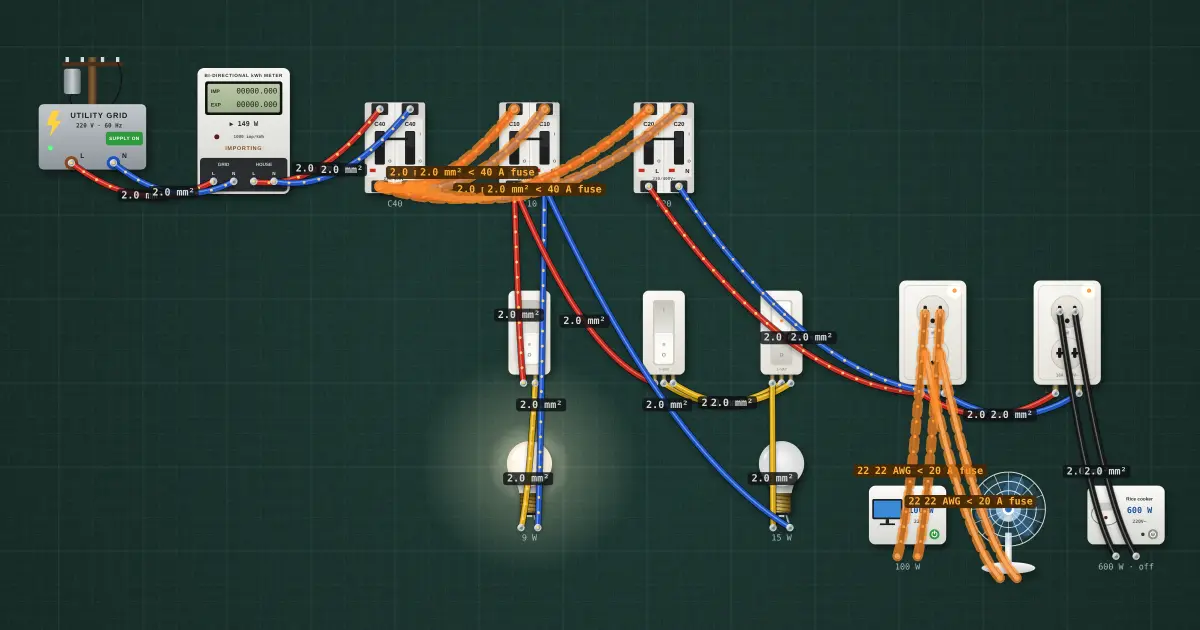
- Click a wire on the house bench and change its size from 3.5 mm² to 2.0 mm² on an outlet circuit with a 20 A breaker, then run the 🛡 Safety check: it should flag the undersized wire.
- Load an outlet circuit with both household appliances and measure the current with the clamp meter. Compare it with the breaker rating.
- Change the wire back to the right size and run the ⏱ Test run to confirm the circuit works.
Parts on the bench
- Utility grid
- Net meter
- 3 × AC breaker
- 3 × Wall switch
- 2 × 220 V bulb
- 2 × Wall outlet
- 2 × Household appliance
- 220 V desk fan
In the course
Electrical Installation and Maintenance (NC II-aligned), module “6 · Roughing-in: conduit, raceways and cables”.