Hand tools, testers and their care
You will be able to pick the right hand tool and tester for each wiring task, use testers safely and keep your tools in a condition that protects you. A damaged tool or the wrong meter is a common cause of accidents.
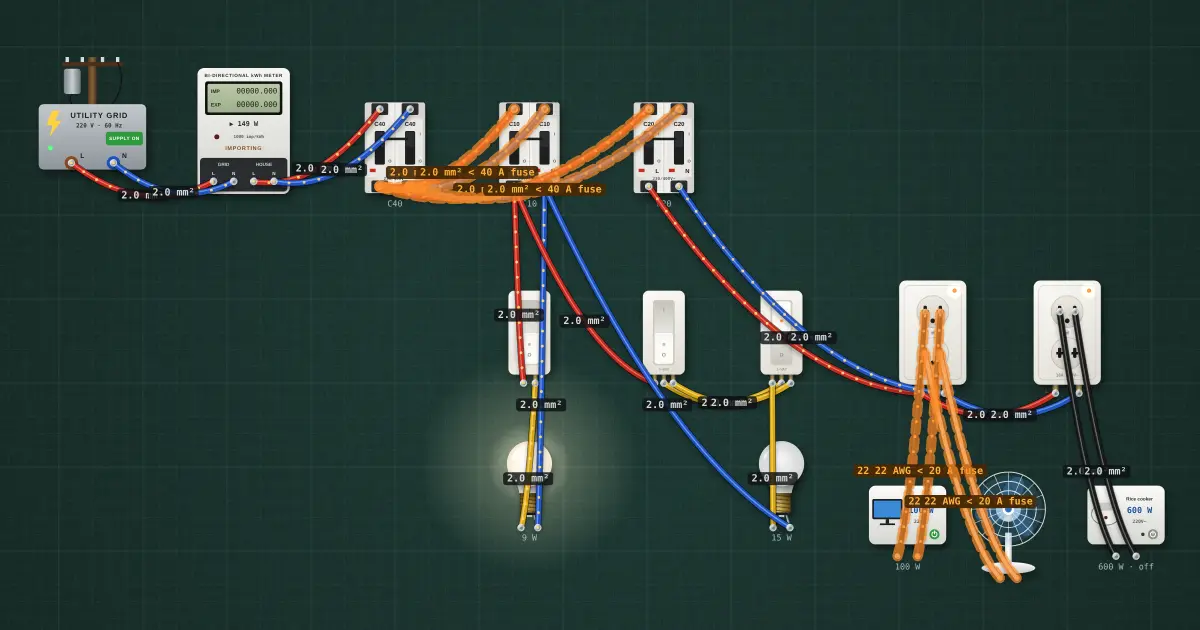
Open this lesson in the labFree, in your browser, no account needed.
How it works
Cutting, gripping and stripping
| Tool | What it is for | Tip |
|---|---|---|
| Lineman's pliers | Gripping, twisting splices, cutting heavier wire | The flat jaws make a tight, even twist on a Western Union or pigtail splice. |
| Long-nose pliers | Bending loops for terminal screws, reaching into boxes | Don't use them to cut thick wire; the tips spring apart. |
| Side-cutting (diagonal) pliers | Cutting wire and cable ties flush | Stay within the cutter's rated wire size; hard steel wire chips the edges. |
| Wire stripper | Removing insulation without nicking copper | Use the notch for the exact wire size; a nick becomes a weak hot spot. |
| Electrician's knife | Opening cable jackets | Cut away from you, at a shallow angle, never into the conductor insulation. |
Driving, cutting and shaping
| Tool | What it is for |
|---|---|
| Screwdrivers (flat and cross-tip, in several sizes) | Terminal screws, device and plate screws. Match the tip to the screw so it doesn't cam out and strip the head. |
| Hacksaw | Cutting conduit, strut and threaded rod. Teeth point forward; cut on the push stroke. |
| Conduit bender (hand bender) or PVC heating method | Bending EMT/IMC to 90°, offsets and saddles; PVC is bent with heat or with factory elbows. |
| Reamer or file | Removing sharp burrs inside a cut conduit so it doesn't strip insulation during the pull. |
| Fish tape | Pushed through a conduit to pull wires back. A steel tape conducts: never push it into a conduit with live wires. |
| Crimping tool | Pressing lugs, ferrules and connectors onto conductors. Use the die that matches the lug size. |
| Electric drill and hole saw | Holes for anchors, boxes and conduit through walls and panels. Wear glasses; clamp the work; use the side handle on large hole saws. |
| Spirit level and tape measure | Straight conduit runs, level boxes and devices, correct mounting heights and take-off lengths. |
| Chalk line, pencil, marker | Marking runs and box positions from the plan. |
Testers
| Tester | What it tells you | Limits |
|---|---|---|
| Non-contact voltage tester (voltage detector pen) | Beeps or lights near a live conductor. Quick check for presence of voltage. | Can miss a live wire (shielded cable, low battery, poor position). Use it as a warning, then confirm with a meter. |
| Multimeter | Voltage (AC and DC), resistance, continuity, sometimes current. The tester for proving dead. | Must be set to the right function; measuring voltage on the resistance or current range can blow it up in your hand. |
| Clamp meter | Current in a conductor without breaking the circuit. | Clamp around one conductor. Around a whole cable, the line and return currents cancel and you read near zero. |
| Continuity tester | Whether a path is complete: a beep for a closed circuit. | Only on de-energized circuits. |
| Insulation-resistance tester | Applies a high DC test voltage (for example 500 V) and reads insulation resistance in megohms. | Disconnect electronics first; the test voltage can damage them. Discharge the circuit after the test. |
| Outlet / polarity tester | Plug-in lights that show wiring faults at an outlet. | Many are made for 120 V grounded-neutral systems. On a Philippine two-hot-wire outlet the "polarity" lights may not mean what the label says. Confirm with a meter. |
Meter safety and CAT ratings
A meter can see a short spike of thousands of volts on a building's wiring, for example from lightning or switching. The measurement category (CAT) on the meter tells you where it can safely be used. The closer you work to the service entrance, the more energy a fault can deliver, so the higher the category you need.
| Category | Where |
|---|---|
| CAT II | Plug-in loads and appliances, outlets away from the panel |
| CAT III | Fixed installation: panelboards, feeders, branch circuits, fixed equipment |
| CAT IV | The origin of the installation: service entrance, utility meter, overhead service drop |
The rating comes with a voltage, such as CAT III 600 V. For building wiring, a meter rated at least CAT III for the voltage is a sensible minimum; CAT IV if you work at the meter and service. The test leads must carry the same or higher rating; leads with shrouded plugs and short metal tips reduce the chance of an arc. A cheap meter with a CAT label but no real fuse protection is not worth the risk.
Checking and caring for tools
- Before each use: look for cracked handles, damaged insulation on insulated tools, loose heads and mushroomed chisels. Check meter leads for cracks and exposed metal.
- Meters: check the battery and fuses; test on a known live source before trusting a reading.
- Cutting tools: keep edges sharp and clean; a blunt stripper tears insulation and a blunt knife slips.
- Moving parts: wipe pliers and crimpers clean and add a drop of oil on the pivot. Keep fish tape coiled in its case and wipe off pulling lubricant.
- Power tools: check cords and plugs, keep guards in place, use the right bit.
- Storage: a dry toolbox or bag with places for each tool, so you notice when something is missing.
Mark unsafe tools. If a tool is damaged, take it out of use immediately: tag it "Do not use" with the fault, and report it. A tool with damaged insulation is worse than no tool, because it gives false confidence.
Insulated hand tools are tested and marked for work near live parts at a stated voltage. A screwdriver wrapped in tape is not an insulated tool.
On the job
- Right tool for the job and the right size for the screw, wire or lug.
- Meter rated for where you measure (CAT III or IV), leads in good condition.
- Non-contact tester to warn, multimeter to prove.
- Damaged tools tagged and set aside.
- Tools counted and cleaned at the end of the day.
Try it on the bench
- Use the multimeter on the house bench to measure the voltage at a wall outlet. Before each reading, check that the meter is set to AC voltage, not resistance or current.
- Clamp the clamp meter around a single wire feeding the desk fan and read the current. Compare with I = P / V for the fan.
- Open a breaker and use the meter in continuity mode across a closed wall switch, then across an open one.
Parts on the bench
- Utility grid
- Net meter
- 3 × AC breaker
- 3 × Wall switch
- 2 × 220 V bulb
- 2 × Wall outlet
- 2 × Household appliance
- 220 V desk fan
In the course
Electrical Installation and Maintenance (NC II-aligned), module “2 · Hand tools and testers”.