Mensuration and electrical calculations
You will be able to take off lengths and quantities from a plan, work out circuit current from power, size a breaker and wire with the 125 % rule for continuous loads, and check voltage drop. These are the numbers behind every materials list and every safe circuit.
Open this lesson in the labFree, in your browser, no account needed.
How it works
Units and conversions
| Quantity | Unit | Useful conversions |
|---|---|---|
| Length | metre (m), millimetre (mm) | 1 m = 1,000 mm; 1 in = 25.4 mm; 1 ft = 0.3048 m |
| Wire cross-section | square millimetre (mm²) | US sizes use AWG and kcmil (see the cables lesson) |
| Area of a floor | square metre (m²) | 1 m² ≈ 10.76 ft² |
| Power | watt (W), volt-ampere (VA) | 1 kW = 1,000 W; 1 hp ≈ 746 W (output power of a motor) |
| Energy | kilowatt-hour (kWh) | 1 kW running for 1 hour |
Lengths and areas from the plan
Area of a rectangular room = length × width. A 4.0 m × 3.5 m room is 14.0 m². Lengths for wiring are taken along the actual route: across the ceiling, then down the wall to the box. A switch at 1.3 m in a room with a 2.7 m ceiling needs a 1.4 m drop (2.7 − 1.3). Forgetting the vertical drops is the most common take-off mistake.
Materials take-off
Wire = run length × number of conductors of that size, plus allowances.
- Allow wire at each box for making up connections. A common practice is about 150 to 200 mm at each box (follow the job spec and the code's minimum free length).
- Allow extra at the panel to reach the breaker and the bars.
- Add a percentage for waste and route changes; many estimators use 5 to 10 %.
Conduit = route length ÷ length of one piece, rounded up. PVC and EMT come in standard lengths (commonly 3 m in the Philippines; check your supplier). Add couplings (one per joint), elbows, connectors (two per box) and straps.
Boxes: count them from the layout. One per outlet, switch and fixture, plus junction and pull boxes.
Worked example. A home run from the panel to the first outlet is 12 m, and the outlets beyond it add 8 m of route. The circuit has 2 hot conductors and a grounding conductor, all 3.5 mm². Route 20 m; there are 4 boxes. Wire per conductor = 20 m + 4 × 0.2 m + 1 m at the panel = 21.8 m. Three conductors: 65.4 m. Add 10 % waste: 71.9 m. Buy in rolls; a 75 m or 150 m roll covers it, depending on the roll sizes available. Conduit: 20 m ÷ 3 m = 6.67, so 7 pieces.
Current from power, single-phase
Ohm's law: V = I × R. Power: P = V × I for a resistive load (heaters, filament lamps). So I = P ÷ V.
Motors, compressors and many electronic loads also draw current that does no useful work. For them, real power P = V × I × power factor (pf), a number from 0 to 1. So I = P ÷ (V × pf). Where the nameplate gives the current, use the nameplate.
- A 1,000 W kettle at 230 V: I = 1,000 ÷ 230 = 4.35 A.
- An aircon rated 1,800 W at 230 V with pf 0.9: I = 1,800 ÷ (230 × 0.9) = 1,800 ÷ 207 = 8.70 A. Ignoring pf would give 7.83 A, an underestimate.
- US note: at 120 V the same 1,000 W kettle draws 8.33 A, nearly twice the current, which is why US homes use larger wire for the same loads.
Continuous loads and the 125 % rule
A continuous load is one expected to run at its full current for 3 hours or more: lighting in a shop, a water heater, an aircon in a bedroom overnight. Standard breakers and their terminals are rated to carry 80 % of their rating continuously. So the code (PEC Article 2.10, branch circuits; NEC 210 in the US) has the branch circuit sized at 125 % of the continuous load plus 100 % of the non-continuous load. 125 % is the same as dividing by 0.8.
Choosing breaker and wire
- Work out the design current (with the 125 % factor where it applies).
- Pick the next standard breaker size at or above that current. Common sizes include 15, 20, 30, 40, 50 and 60 A.
- Pick a wire whose ampacity, from the table in PEC Article 3.10 (NEC 310) for the insulation type and installation, is at least that current and is protected by the breaker. The breaker protects the wire, so the wire must never be smaller than the breaker allows.
- Check voltage drop for long runs and go up a size if needed.
Worked example. A 3,000 W water heater, continuous, at 230 V. I = 3,000 ÷ 230 = 13.04 A. × 1.25 = 16.3 A. Next standard breaker: 20 A. Wire rated for 20 A on its own circuit: in common Philippine practice, 3.5 mm² THHN with a 20 A breaker. If the manufacturer's sheet specifies a breaker size, follow it.
Voltage drop
Every wire has resistance, so a long circuit loses some voltage before the load. For a two-wire single-phase circuit, current flows out on one wire and back on the other, so the length is counted twice:
Voltage drop = 2 × L × I × ρ ÷ A
where L is the one-way length in metres, I the current in amperes, A the conductor area in mm², and ρ the resistivity of copper: use 0.0175 Ω·mm²/m (0.0172 at 20 °C, rounded up a little for working temperature). Copper's resistance rises as it warms (roughly 20 % higher at 75 °C), so a hot, heavily loaded wire drops a little more than the formula gives.
Worked example. A 10 A load, 50 m from the panel, on 2.0 mm² wire: drop = 2 × 50 × 10 × 0.0175 ÷ 2.0 = 8.75 V. At 230 V that is 8.75 ÷ 230 = 3.8 %. On 3.5 mm²: 2 × 50 × 10 × 0.0175 ÷ 3.5 = 5.0 V, which is 2.2 %. The bigger wire brings the drop under 3 %.
Guidance, not a rule: the code, like the NEC, includes an informational note recommending a drop of no more than about 3 % on a branch circuit and 5 % total for feeder plus branch, for good operation. It is a recommendation for efficiency and performance; the job spec may set its own limit.
On the job
- Take lengths along the real route, with drops to every box.
- Wire = route × conductors + box and panel allowances + waste.
- I = P ÷ V, or P ÷ (V × pf) for motors; nameplate current wins.
- Continuous load × 1.25 → breaker → wire the breaker protects.
- Long run? Check the voltage drop.
Try it on the bench
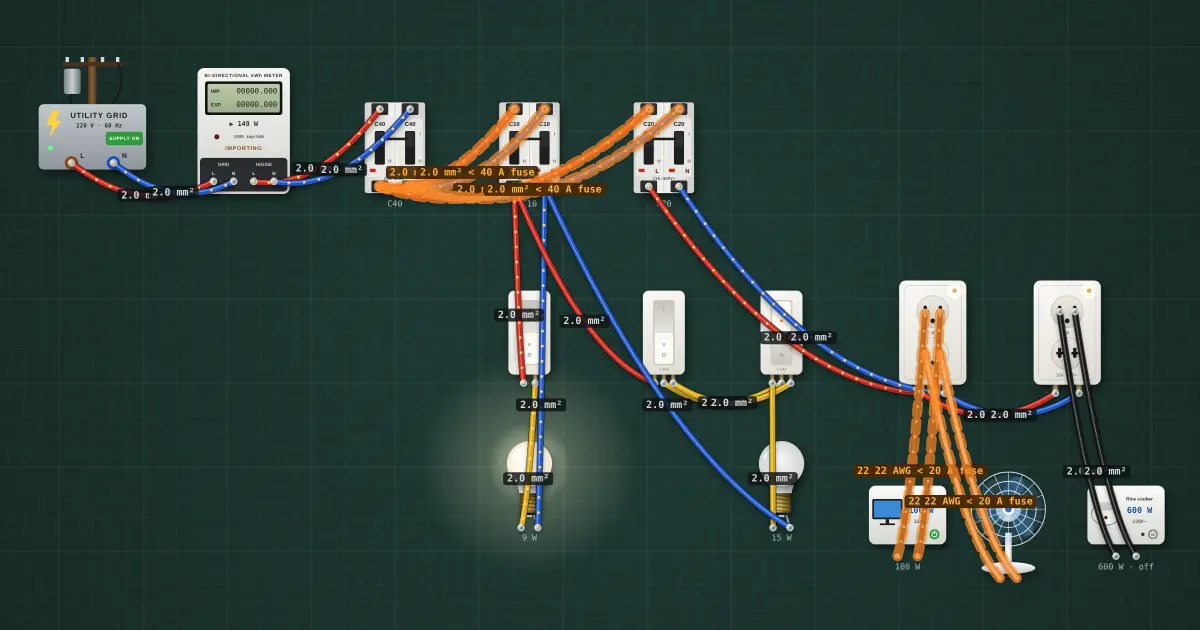
- Read the wattage of the desk fan and an appliance, work out I = P / V at 230 V, then check with the clamp meter. A gap between the two can be the power factor.
- Click a long wire on the house bench and change its size: compare the voltage at the load with the multimeter before and after.
- Put the two household appliances on one circuit, add their currents and see whether the breaker still has margin. Run the 🛡 Safety check.
Parts on the bench
- Utility grid
- Net meter
- 3 × AC breaker
- 3 × Wall switch
- 2 × 220 V bulb
- 2 × Wall outlet
- 2 × Household appliance
- 220 V desk fan
In the course
Electrical Installation and Maintenance (NC II-aligned), module “4 · Calculations: load, breaker, wire and voltage drop”.