Electrical safety, PPE and lockout/tagout
You will be able to name the main electrical hazards, choose the right PPE, prove a circuit dead before touching it and lock it out so nobody can switch it back on. These habits are what keep an electrician alive for a whole career.
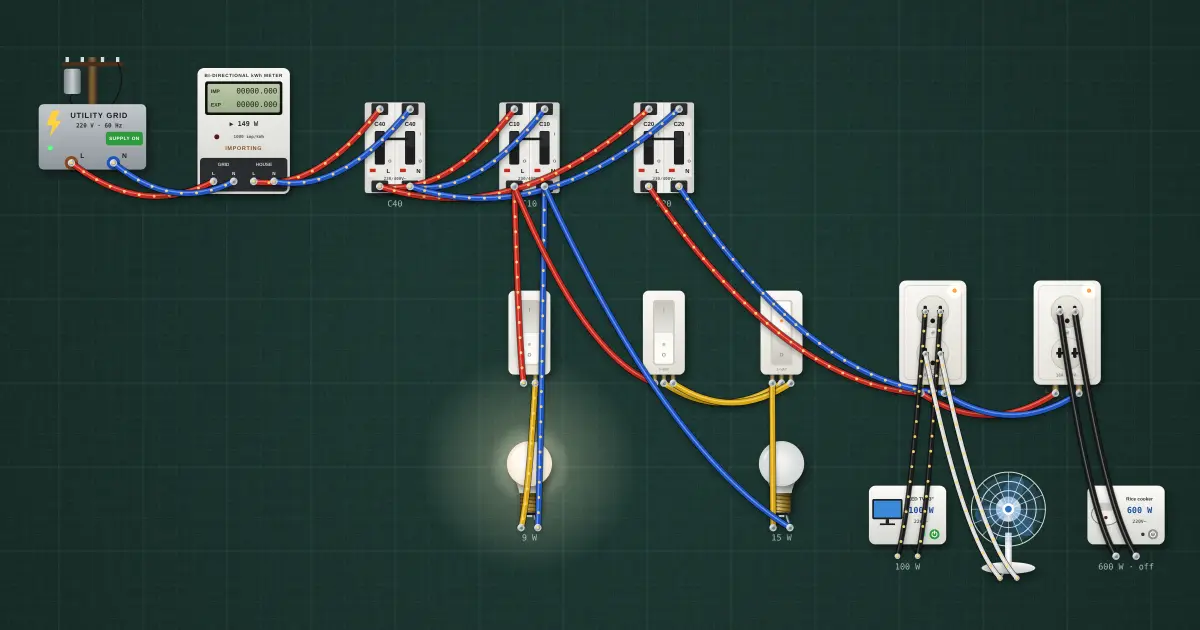
Open this lesson in the labFree, in your browser, no account needed.
How it works
Two hazards: shock and arc
A shock happens when your body becomes part of a circuit: one hand on a live wire and your feet on a damp floor, or one hand on each of two wires. An arc flash happens when a fault jumps through air, for example a screwdriver slipping across two terminals in a panel. The arc is hotter than a welding torch for a split second. It burns skin and eyes, melts metal into droplets and throws a pressure wave. You don't need to touch anything to be hurt by an arc; you only need to be close.
How current through the body hurts
It is the current, not the voltage by itself, that does the damage, but voltage is what pushes current through your skin. Wet skin, sweat and cuts lower your resistance, so the same 230 V drives much more current. The figures below are rough and vary from person to person; treat them as orders of magnitude, not limits.
| Current through the body (AC) | Typical effect |
|---|---|
| About 1 mA | A tingle you can just feel |
| Around 10 mA and up | Muscles clamp; many people can no longer let go of the wire |
| Tens of mA through the chest | Breathing can stop and the heart can go into fibrillation (it quivers instead of pumping) |
| Larger currents | Deep burns along the current path, damage to nerves and organs |
The path matters. Hand to hand or hand to foot crosses the chest and the heart. That is why a 30 mA RCD is used for shock protection: it trips before most people reach the dangerous range. Burns inside the body may not show on the skin, so anyone who had a real shock should be checked by a doctor even if they feel fine.
Personal protective equipment (PPE)
- Safety glasses or a face shield: arcs, flying wire ends, drilling dust.
- Insulating gloves rated for the voltage, checked for holes before use (roll the cuff and squeeze to see if air leaks). Leather protectors go over rubber gloves.
- Safety shoes with non-conductive soles, no exposed metal.
- Hard hat where things can fall or where you work under beams, of a non-conductive type.
- Cotton or flame-resistant clothing, long sleeves. Synthetic fabrics can melt into skin in an arc. Remove rings, watches and metal necklaces.
- Insulated tools for work near live parts, and a rubber mat in front of panels where the job calls for it.
PPE is the last line of defence. The first is to switch off, lock out and prove the circuit dead.
Test before touch
- Check the tester on a known live source (an outlet you know is on, or a proving unit).
- Test the circuit you will work on: every conductor to every other conductor and each one to ground.
- Check the tester again on the known live source. If it died in between, your "dead" reading meant nothing.
Philippine services: many 230 V services are line-to-line. Both wires are "hot", each about 115 V to ground on some systems. Switching off one pole, or assuming the wire without a switch is a safe neutral, can leave you holding a live conductor. Test both wires to ground and to each other, and use a two-pole breaker or switch to isolate. Where a service has a true grounded neutral (common in many countries with 230 V, and in the US 120/240 V split-phase), the neutral can still carry current from other circuits if it is shared, so test it too.
Lockout/tagout (LOTO)
- Prepare: know every source that feeds the equipment (main, sub-panel, a generator or inverter, a solar system).
- Notify the people affected that power will be off.
- Switch off at the breaker or disconnect, not only at a wall switch.
- Lock the device in the off position with your own padlock. One lock per worker; you keep your key.
- Tag it: your name, the date, why it is off and how to reach you.
- Release stored energy: capacitors in drives, inverters and some fixtures can hold a charge.
- Verify: try the switch or the equipment, then test before touch as above.
Only the person who put the lock on removes it, after checking that tools are out, covers are back and people are clear.
Ladders and work at height
- Use a non-conductive ladder (fibreglass or dry wood) for electrical work, never aluminium near live parts.
- Set an extension ladder at about 1 out for every 4 up, on firm level ground, and tie it off or have someone foot it.
- Keep three points of contact; carry tools in a belt or haul them up with a rope.
- Don't stand on the top rungs of a stepladder. Open it fully and lock the spreaders.
- Above the height your site rules set, use a harness and a proper anchor, or a scaffold with guardrails.
When someone gets a shock
- Do not touch them while they may still be in contact with the source.
- De-energize first: open the breaker or main, or unplug. If you can't, push the person or the wire away with a dry non-conductive object (dry wood, plastic) while standing on something dry.
- Call for help and emergency services.
- Check breathing. If they are not breathing normally, start CPR if you are trained, and use an AED if one is available.
- Cool burns with clean running water and cover loosely. Keep them still and warm until help arrives.
Electrical fires
Cut the power first if you can do it safely. On energized equipment use an extinguisher rated for electrical fires: Class C in the US-style system used in the Philippines, which in practice means carbon dioxide (CO2) or dry chemical. Other countries label classes differently, so read the label on the extinguisher. Never use water or foam on live equipment: it conducts. Once the circuit is dead, the fire becomes an ordinary fire of whatever is burning.
Housekeeping
A tidy site is a safe site. Keep walkways clear of wire offcuts and tools, cover open boxes, sweep up metal shavings near panels, keep the area around panels free (never use it as storage), and keep floors dry where you work. Put scrap copper and insulation in a bin at the end of the day.
On the job
- PPE on, metal jewellery off.
- Switch off at the breaker, lock and tag it.
- Test the tester, test every wire (both hot wires on a two-wire service), test the tester again.
- Non-conductive ladder, set and secured.
- Know where the main breaker, first-aid kit and extinguisher are before you start.
Try it on the bench
- Open the breaker that feeds one wall outlet, then measure the outlet with the multimeter: it should read 0 V. Measure an outlet on another breaker first and after, to "test the tester".
- Turn a wall switch off and measure each lamp terminal to ground. If either still reads a voltage, the lamp is not safe to touch: that is why you isolate at the breaker, not the switch.
- Run the 🛡 Safety check on the house bench and read what it flags before you change anything.
Parts on the bench
- Utility grid
- Net meter
- 3 × AC breaker
- 3 × Wall switch
- 2 × 220 V bulb
- 2 × Wall outlet
- 2 × Household appliance
- 220 V desk fan
In the course
Electrical Installation and Maintenance (NC II-aligned), module “1 · Electrical safety and PPE”.